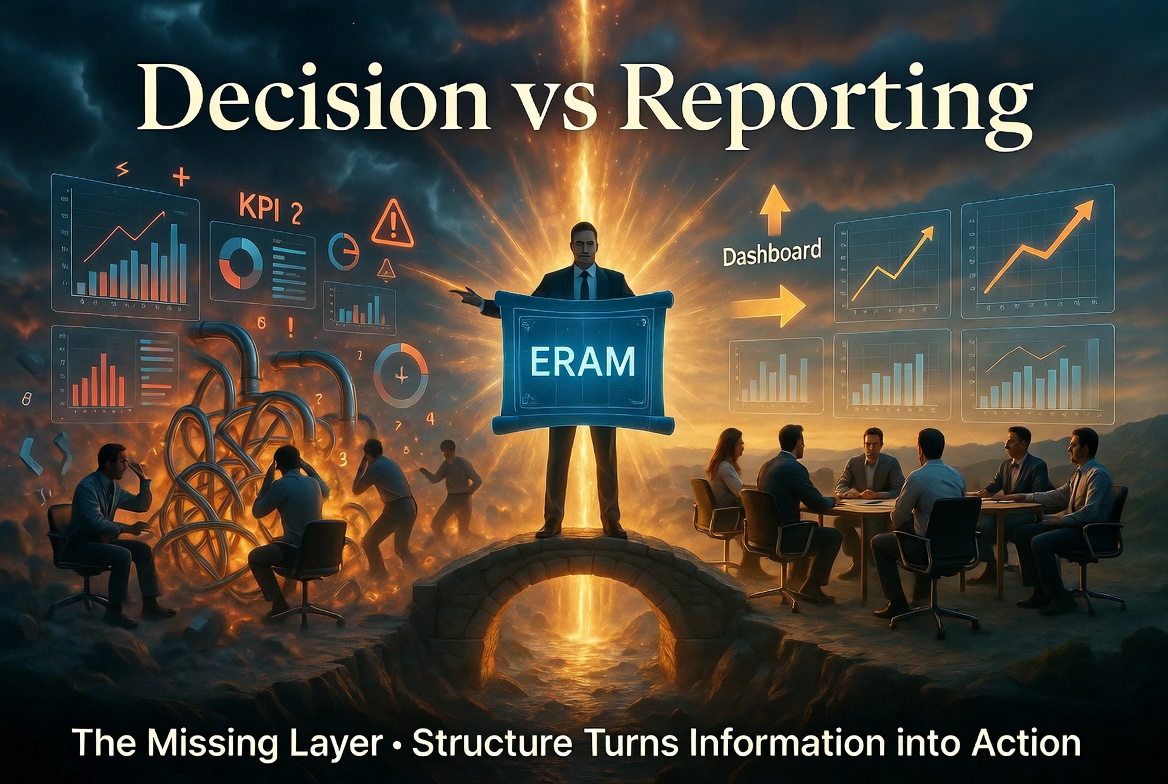
Decision vs Reporting: The Missing Layer in Most Businesses
Decision vs Reporting: The Missing Layer in Most Businesses
Modern organizations produce more reports than ever before.
Dashboards.
KPIs.
Visualizations.
Metrics.
Every department tracks something.
At first glance, this appears to be progress.
Businesses believe they are becoming “data-driven.”
But beneath the surface, a critical problem often exists:
·Reporting is increasing…
·while decision quality remains unchanged.
·Meetings still lack clarity.
·Teams still debate numbers.
·Executives still rely on instinct over systems.
Why?
Because reporting and decision-making are not the same thing.
And most businesses are missing the layer that connects them.
---
The Illusion of Being Data-Driven
Many organizations assume that more reporting automatically leads to better decisions.
It feels logical:
More visibility should create more clarity.
But this assumption is flawed.
Reporting provides information.
Decision systems provide direction.
These are not equivalent.
A company can have:
• Dozens of dashboards
• Hundreds of KPIs
• Real-time analytics
And still struggle to make reliable decisions.
Because visibility alone is not enough.
Genesis Principle: Function Requires Structure
In Genesis, structure always precedes function.
Creation unfolds in sequence:
·Order.
·Separation.
·Organization.
·Then purpose.
Nothing meaningful emerges from chaos.
This principle applies directly to business systems.
Many organizations attempt to create decisions before creating clarity.
They display data before building understanding.
As a result, reporting exists…
but decision systems do not.
The Difference Between Reporting and Decision Systems
Reporting answers:
“What happened?”
Decision systems answer:
“What should we do next?”
This distinction is critical.
Reporting is descriptive.
Decision systems are operational.
A report may show declining sales.
But a decision system:
• Clarifies why
• Identifies impact
• Aligns stakeholders
• Supports action
Without this layer, dashboards become passive displays.
They inform without guiding.
Why Most Businesses Stop at Reporting
There are several reasons organizations remain stuck at the reporting layer:
1. Dashboards are visible
Executives can see them immediately.
2. Reporting feels measurable
It creates the appearance of progress.
3. Decision systems are harder to design
They require alignment, structure, and governance.
As a result, many companies optimize for visibility instead of decision quality.
---
The Missing Layer: Structured Interpretation
Between reporting and decision-making lies a missing layer:
Interpretation.
This is where data becomes meaning.
It includes:
• KPI alignment
• Contextual understanding
• Business logic consistency
• Structured governance
Without interpretation, data remains fragmented.
Each team creates its own understanding.
And decision-making becomes inconsistent.
What Happens Without This Layer
When organizations lack structured interpretation:
• Teams argue over definitions
• Metrics are interpreted differently
• Dashboards produce conflicting narratives
• Decisions slow down
Over time, trust erodes.
People stop relying on reports.
They create manual validations.
They rely more on intuition than systems.
The result is not clarity.
It is organizational friction.
The ERAM Perspective: Reporting Is the Final Layer
The ERAM methodology addresses this issue by redefining the role of dashboards.
Dashboards are not the system.
They are the output of the system.
Before reporting comes:
1. Business objective alignment
2. Grain definition
3. Structured transformation
4. Consistent modeling
5. Controlled logic
6. Validation
Only then does reporting become meaningful.
Because only then can dashboards support decisions instead of confusion.
Why Decision Systems Create Competitive Advantage
Organizations that move beyond reporting gain a major advantage.
They:
• Make faster decisions
• Align teams more effectively
• Reduce internal conflict
• Increase trust in systems
This creates operational clarity.
And operational clarity compounds over time.
While competitors debate numbers…
Structured organizations execute.
The Problem with KPI Obsession
Many businesses believe more KPIs create better visibility.
But excessive metrics often create noise.
When every number is important…
nothing is.
Decision systems simplify.
They identify:
• Which metrics matter
• Which signals require action
• Which outcomes drive the business
This requires discipline.
Not just reporting capability.
Real-World Example
Consider a retail company with dozens of dashboards.
·Marketing tracks campaigns.
·Finance tracks margins.
·Operations track inventory.
Each department has visibility.
But when sales decline:
• Different teams blame different causes
• Reports conflict
• No unified decision emerges
The issue is not lack of reporting.
It is lack of decision infrastructure.
Once the organization aligns definitions, models data consistently, and structures decision logic:
·Reports stop competing.
·And decisions accelerate.
From Reporting Culture to Decision Culture
This shift is cultural as much as technical.
A reporting culture asks:
“What data do we have?”
A decision culture asks:
“What action should this system support?”
This changes everything.
Because the goal is no longer visibility.
It becomes clarity.
Why Structure Matters More Than Visualization
Many organizations continue investing heavily in:
• Better dashboards
• More visuals
• New reporting tools
But tools cannot compensate for structural weakness.
If:
• Definitions are inconsistent
• Logic is fragmented
• Models are unstable
Then reporting simply amplifies confusion faster.
This is why structure matters more than visualization.
Genesis as a Strategic Framework
The Genesis pattern reveals a timeless principle:
Order → Clarity → Function → Growth
Most organizations stop at visibility.
But visibility without structure cannot sustain decisions.
Decision systems require:
• Order
• Alignment
• Interpretation
• Governance
Only then does information become actionable.
Conclusion: Reporting Is Not the Goal
Businesses often believe the objective is reporting.
It is not.
The objective is reliable decision-making.
Reporting is only valuable if it supports action.
So before building another dashboard…
Ask a more important question:
Does this system improve decisions?
Because in the end:
Dashboards do not create competitive advantage.
Decision systems do.
If your organization:
• Produces many reports but still struggles with decisions
• Experiences conflicting interpretations of KPIs
• Has dashboards that create more debate than action
The issue may not be reporting.
It may be the missing layer between information and decision.
Start there.
Everything else will follow.
Related Resources
Discover the Eden Reporting Architecture Method (ERAM) — a practical framework for building trusted decision infrastructure, KPI alignment, and scalable reporting systems.
Evaluate your reporting environment with an ERAM Audit and identify hidden risks related to KPI definitions, reporting trust, governance, and decision-making reliability.
