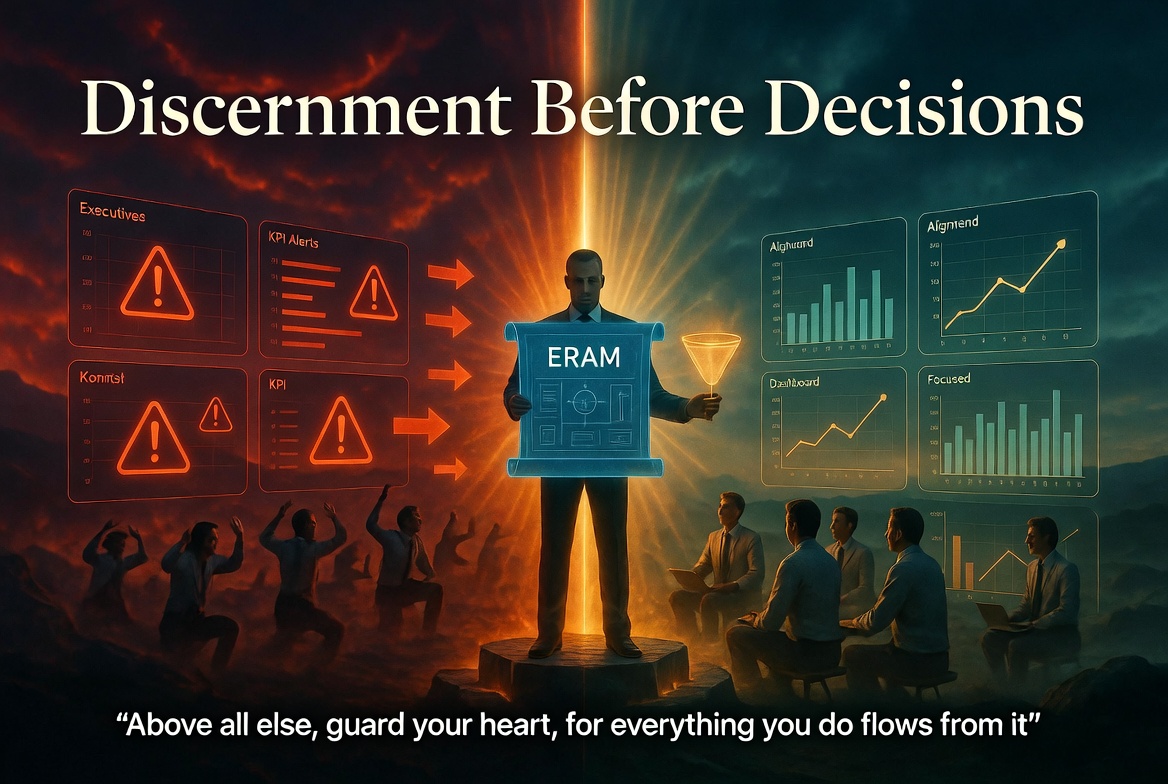
Discernment before decisions
Discernment Before Decisions – Why Not Every Insight Deserves Action
“Above all else, guard your heart, for everything you do flows from it.” — Proverbs 4:23
Introduction
Modern organizations do not suffer from a shortage of information. They suffer from an abundance of it.
Dashboards, KPIs, alerts, forecasts, AI-generated recommendations, predictive models, and executive reports continuously compete for attention. Leaders are surrounded by signals.
The challenge is no longer obtaining information.
The challenge is deciding which information deserves action.
This is where discernment becomes one of the most valuable capabilities in business.
Knowledge tells us what happened.
Understanding helps explain why it happened.
Wisdom helps determine what should be done.
Discernment determines whether action is even necessary.
Not every insight deserves a project.
Not every anomaly deserves an investigation.
Not every trend deserves a strategic response.
Organizations that fail to develop discernment become trapped in constant reaction.
The Cost of Acting on Every Signal
Many organizations assume responsiveness is always positive.
If a metric changes, respond.
If a dashboard highlights a trend, respond.
If AI generates a recommendation, respond.
Over time this creates a culture of perpetual reaction:
Resources become fragmented.
Teams chase competing priorities.
Leadership attention becomes diluted.
The organization becomes busy but not necessarily effective.
One of the hidden costs of poor discernment is strategic distraction.
When everything appears important, nothing remains important.
Biblical Wisdom and Discernment
Throughout Scripture, discernment is presented as a mark of maturity.
Wise leaders learn to distinguish:
- urgency from importance
- appearance from reality
- opportunity from distraction
- signal from noise
This distinction has become increasingly important in modern reporting environments.
The amount of available information continues to grow.
The ability to prioritize becomes increasingly valuable.
Why AI Increases the Need for Discernment
Artificial intelligence is transforming decision systems.
AI can identify patterns, summarize data, generate forecasts, detect anomalies, and recommend actions faster than any human team.
This creates enormous value.
It also creates a new challenge.
AI can generate more recommendations than organizations can realistically act upon.
The future problem will not be lack of insights.
The future problem will be selecting the right insights.
AI may identify ten opportunities.
Discernment identifies the one that matters.
AI may detect twenty anomalies.
Discernment determines which anomaly deserves attention.
Information becomes abundant.
Judgment becomes scarce.
Manufacturing Example
Imagine a manufacturing company implementing AI-driven operational analytics.
The system identifies dozens of issues:
- minor downtime increases
- small quality deviations
- inventory fluctuations
- scheduling inefficiencies
Every issue appears important.
Leadership begins launching initiatives everywhere.
Teams become overwhelmed.
After months of effort, little improvement occurs.
The organization was not lacking information.
It was lacking discernment.
A second company approaches the situation differently.
Every signal is evaluated against strategic objectives.
Only the highest-impact constraints receive attention.
Resources remain focused.
Results improve significantly.
The difference is not technology.
The difference is discernment.
CRM Example
Consider a CRM environment.
An analytics platform highlights:
- declining lead volume
- changes in email engagement
- shifts in sales activity
- fluctuations in conversion rates
Without discernment, every signal becomes a priority.
Marketing changes campaigns.
Sales changes processes.
Leadership changes targets.
The organization enters a cycle of constant adjustment.
Eventually teams realize that revenue remained healthy throughout.
Many responses addressed symptoms rather than meaningful problems.
Discernment prevents overreaction.
Discernment and ERAM
The Eden Reporting Architecture Method supports discernment by improving information quality and context.
Step 1: Define Business Objective
Objectives create filters.
Without objectives, every metric appears relevant.
With objectives, leaders can evaluate signals against strategic priorities.
Step 2: Define Grain
Discernment requires understanding what the data actually represents.
Incorrect grain often produces misleading conclusions.
Step 3: Transform Data
Transformation introduces business context.
Good transformations improve interpretation.
Poor transformations create noise.
Step 4: Enforce Star Schema
Strong architecture improves signal quality.
Weak architecture generates confusion.
Discernment becomes difficult when structure is unreliable.
Step 5: Build Layered DAX
Transparent logic supports better interpretation.
Discernment depends on understanding assumptions.
Step 6: Stress Test Model
Reliable signals require testing.
Discernment improves when leaders trust the information they receive.
Step 7: Validate With Source
False information produces false priorities.
Validation protects decision quality.
Step 8: Design Dashboard
Dashboard design should support attention management.
The best dashboards help leaders focus on what matters most.
The Maturity Advantage
Immature organizations react to everything.
Mature organizations filter effectively.
As reporting environments become more complex, the ability to ignore distractions becomes a competitive advantage.
Discernment is not the absence of action.
Discernment is disciplined action.
It helps organizations preserve attention for the decisions that matter most.
The ERAM Audit and Discernment
An ERAM Audit often reveals organizations overwhelmed by information but lacking prioritization.
The audit evaluates:
- KPI alignment
- objective clarity
- governance maturity
- reporting trust
- decision effectiveness
Many organizations discover they do not need more dashboards.
They need better filters.
Discernment creates those filters.
The Future Belongs to Disciplined Decision Makers
Technology will continue advancing.
AI will continue generating insights.
Analytics will continue expanding.
Information advantages will become less significant.
Discernment advantages will become more significant.
Organizations that thrive will not necessarily be those with the most information.
They will be those that know what deserves attention.
Conclusion
The modern challenge is not collecting information.
The modern challenge is interpreting priorities.
Knowledge explains what happened.
Understanding explains why.
Wisdom suggests what should be done.
Discernment determines whether action is required at all.
Organizations that cultivate discernment avoid distractions, focus resources more effectively, and make better decisions.
In an age overflowing with information, discernment may become one of the most valuable capabilities a leader can develop.
Previous Article: Understanding before action
Next Article: The fear of the Lord is the beginning of wisdom
Related Resources
Discover the Eden Reporting Architecture Method (ERAM) — a practical framework for building trusted decision infrastructure, KPI alignment, and scalable reporting systems.
Evaluate your reporting environment with an ERAM Audit and identify hidden risks related to KPI definitions, reporting trust, governance, and decision-making reliability.
