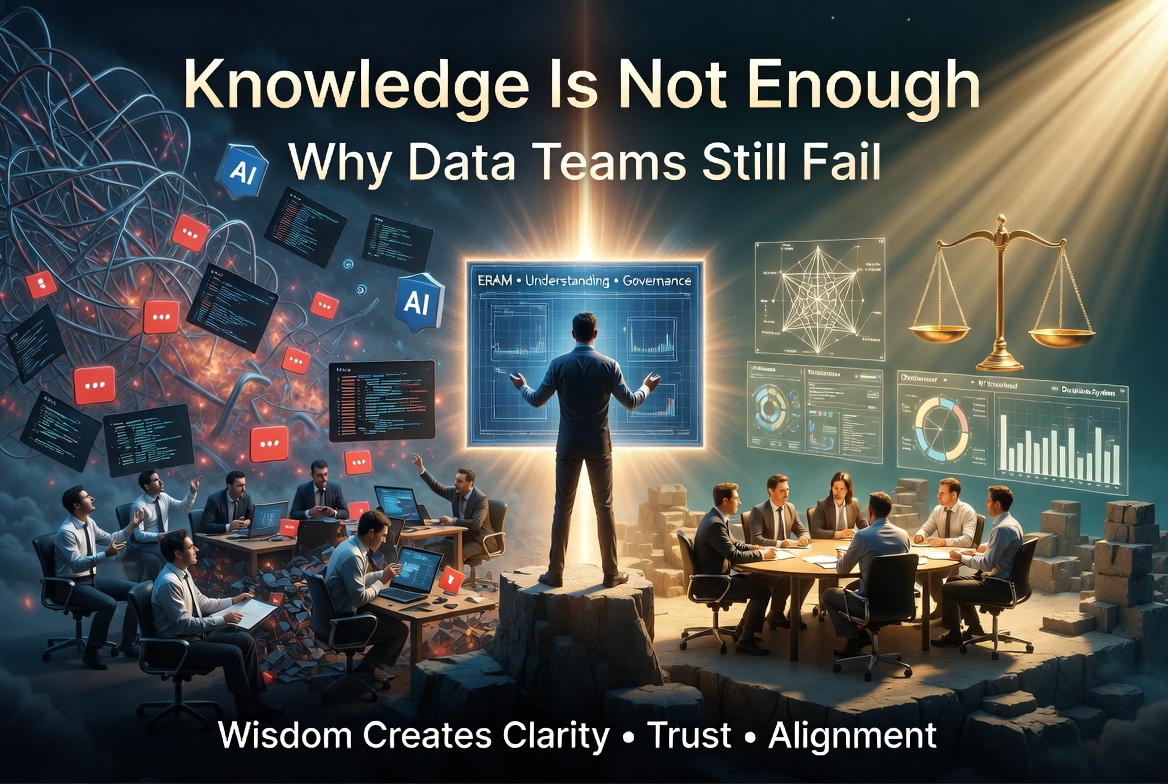
Knowledge is not enough
Knowledge Is Not Enough: Why Data Teams Still Fail
Introduction: The Knowledge Paradox
Modern organizations have more knowledgeable data teams than ever before.
·Analysts understand DAX.
·Engineers build sophisticated pipelines.
·Architects design scalable infrastructures.
·Teams deploy AI-driven analytics environments.
Yet despite this growing technical capability, many organizations still struggle with:
• conflicting KPIs
• poor decision-making
• dashboard mistrust
• reporting chaos
• organizational misalignment
Why?
Because knowledge alone is not enough.
This is one of the most important distinctions organizations fail to recognize.
Technical knowledge can build systems.
But it does not automatically create clarity, trust, alignment, or wise decisions.
This explains why highly intelligent data teams can still create environments that fail organizationally.
And in many cases, the problem is not technical capability.
It is the absence of structured understanding and wisdom.
---
The Modern Data Team Illusion
Most organizations assume that if they hire highly skilled technical people, decision-making quality will naturally improve.
The logic seems obvious:
• better engineers
• better analysts
• better tools
• more automation
should produce:
• better reporting
• better decisions
• better organizational clarity
But reality often unfolds differently.
Teams become more technically sophisticated while organizations become more operationally confused.
Why?
Because technical excellence and organizational wisdom are not the same thing.
---
Knowledge Solves Problems. Wisdom Prevents Them.
This distinction is critical.
Knowledge often focuses on solving visible issues:
• fixing broken calculations
• optimizing performance
• redesigning dashboards
• correcting data quality issues
Wisdom asks a different question:
Why are these problems repeatedly occurring?
Wisdom looks beneath the symptom.
It investigates:
• structural weakness
• governance failure
• unclear ownership
• fragmented definitions
• organizational incentives
This difference changes everything.
Because many organizations continuously fix reporting symptoms while leaving the underlying architecture unstable.
---
The Proverbs Principle: Understanding Before Action
The wisdom literature of Proverbs consistently emphasizes understanding before action.
Not speed.
Not impulsiveness.
Not reactive behavior.
Understanding.
This principle directly applies to reporting architecture.
Many organizations rush into:
• dashboards
• AI tools
• visualizations
• advanced analytics
before fully understanding:
• the business objective
• KPI ownership
• data grain
• governance responsibilities
• decision-making context
As a result:
• visibility increases
• confusion expands
• trust weakens
Knowledge creates activity. Understanding creates alignment.
---
The ERAM Perspective: Architecture Before Visibility
This is one of the reasons the ERAM methodology emphasizes sequence so strongly.
ERAM does not begin with dashboard design.
It begins with:
1. Define Business Objective
2. Define Grain
These first two steps are deeply connected to understanding.
Before calculations.
Before visuals.
Before KPIs.
ERAM asks:
• What problem are we solving?
• What does each row represent?
• What decision should this system support?
• What level of detail creates clarity instead of distortion?
This architectural discipline prevents many downstream reporting failures.
Because wisdom-driven systems are proactive, not reactive.
Why Technical Teams Still Create Fragile Systems
A highly knowledgeable team can still create unstable reporting environments.
How?
Because technical intelligence alone does not guarantee:
• aligned definitions
• governance maturity
• decision clarity
• scalability
• organizational trust
For example:
A technically advanced team may create:
• highly optimized DAX
• complex semantic models
• real-time dashboards
Yet if KPI definitions differ between Finance and Operations, leadership meetings will still become debates.
The system may be technically sophisticated while remaining organizationally fragile.
This is the hidden difference between intelligence and wisdom.
The Problem of KPI Fragmentation
One of the clearest examples of this failure appears in KPI governance.
Different departments frequently define the same metric differently:
• revenue
• customer acquisition
• active users
• margin
• churn
Technically, each team may be correct within its own context.
But organizationally, fragmentation destroys clarity.
This is why many organizations have dashboards everywhere but alignment nowhere.
Knowledge builds reports. Wisdom builds shared understanding.
Why Complexity Often Hides Weakness
Modern BI environments frequently become extremely complex.
·More dashboards.
·More transformations.
·More semantic layers.
·More calculations.
Organizations often interpret this complexity as maturity.
But complexity can also hide structural weakness.
Weak systems frequently compensate through:
• manual processes
• undocumented logic
• duplicated calculations
• inconsistent assumptions
Over time, complexity becomes a substitute for clarity.
This creates technical debt and organizational confusion simultaneously.
Wisdom simplifies.
Not because simplicity is easier.
But because clarity scales better than confusion.
The Leadership Failure Behind Many Reporting Problems
Many reporting failures are not technical failures. They are leadership failures.
Leadership shapes:
• governance discipline
• KPI ownership
• reporting culture
• accountability expectations
When leadership prioritizes speed over clarity:
• dashboards multiply rapidly
• standards weaken
• definitions drift
• trust declines
When leadership prioritizes understanding:
• governance improves
• architecture stabilizes
• reporting aligns
• decisions accelerate
This is why reporting architecture is not merely technical infrastructure.
It is organizational infrastructure.
The AI Acceleration Problem
Artificial intelligence is intensifying this challenge.
Organizations now generate:
• AI summaries
• predictive analytics
• conversational reporting
• automated insights
But AI does not replace understanding. AI scales knowledge. It does not inherently scale wisdom.
If the underlying architecture is weak:
• inconsistent definitions spread faster
• flawed assumptions scale broadly
• misleading conclusions appear more authoritative
This creates a dangerous illusion:
Organizations may appear increasingly intelligent while becoming strategically confused.
This is why governance and structure matter even more in the AI era.
The Difference Between Data Teams and Decision Teams
Many organizations build data teams. Few intentionally build decision systems.
This is an important distinction.
A data team focuses on:
• pipelines
• dashboards
• analytics
• tooling
A decision-oriented organization focuses on:
• clarity
• trust
• alignment
• governance
• consequences
• decision quality
The second approach requires much more than technical knowledge.
It requires organizational wisdom.
Real-World Example: The Executive Dashboard Problem
Consider a company where executives receive multiple strategic dashboards.
Sales shows one growth number.
Finance reports another.
Operations presents a third variation.
The analysts behind these reports may all be highly competent. Yet leadership confidence declines.
Why?
Because the issue is no longer technical.
It is interpretational and organizational.
The company lacks:
• shared definitions
• governance alignment
• architectural discipline
The result is not simply reporting confusion.
It is weakened decision-making.
This is exactly the type of problem ERAM attempts to prevent through structured architecture.
Why Wisdom Scales Better Than Intelligence Alone
Intelligence can optimize systems. Wisdom determines whether the system should exist in its current form at all.
This is a crucial difference.
Intelligence improves execution. Wisdom improves direction.
Organizations that scale sustainably usually possess:
• disciplined governance
• clear ownership
• aligned metrics
• trusted systems
• structured decision-making
These qualities emerge from wisdom-oriented architecture.
Not merely technical capability.
From Reporting to Organizational Understanding
One of the most important evolutions in modern BI is moving from reporting toward organizational understanding.
Reporting answers:
“What happened?”
Understanding asks:
“What does this mean for the organization?”
Wisdom asks:
“What should we do next?”
This progression is critical.
Without it, organizations become trapped in visibility without clarity.
Conclusion: Knowledge Alone Cannot Create Clarity
Modern organizations do not primarily fail because of lack of technical knowledge.
Many possess highly capable data teams.
They fail because:
• definitions drift
• governance weakens
• understanding fragments
• trust declines
• decision systems remain unstable
Knowledge is valuable.
But knowledge alone is not enough.
Reliable decision environments require:
• structure
• governance
• understanding
• alignment
• architectural discipline
This is why ERAM prioritizes sequence and clarity before visibility.
Because the ultimate goal of business intelligence is not technical sophistication. It is reliable organizational decision-making.
And reliable decisions require more than knowledge.
They require wisdom.
If your organization experiences:
• conflicting dashboards
• KPI fragmentation
• lack of trust in reporting
• endless metric debates
• slow executive decisions
The issue may not be technical capability. It may be the absence of structured understanding. And understanding begins with architecture.
Previous Article: wisdom before visibility
Next Article : Why good data still leads to bad decision
Related Resources
Discover the Eden Reporting Architecture Method (ERAM) — a practical framework for building trusted decision infrastructure, KPI alignment, and scalable reporting systems.
Evaluate your reporting environment with an ERAM Audit and identify hidden risks related to KPI definitions, reporting trust, governance, and decision-making reliability.
