Rooted by Streams: What Psalm 1 Reveals About Decision Systems
Rooted by Streams: What Psalm 1 Reveals About Decision Systems
Introduction: Why Some Organizations Flourish While Others Collapse
Modern organizations invest heavily in dashboards, analytics platforms, AI tools, and reporting systems.
Yet despite all this visibility, many organizations still struggle with:
• reactive leadership
• KPI conflicts
• operational confusion
• declining trust
• unstable decision-making
At the same time, other organizations appear remarkably stable.
Their decisions are more consistent.
Their operations remain aligned.
Their growth compounds sustainably.
Their leadership teams maintain clarity under pressure.
Why?
Psalm 1 provides a surprisingly powerful framework for understanding this difference.
Although written thousands of years ago, Psalm 1 reveals timeless principles about:
• foundations
• influence
• consistency
• discipline
• fruitfulness
• long-term prosperity
And when viewed through the lens of modern business intelligence and decision infrastructure, the parallels become extraordinary.
This Psalm is not only about personal wisdom.
It is also a profound model for organizational wisdom.
Two Types of Organizations
Psalm 1 begins by contrasting two types of people.
But the principle can also be applied to organizations.
One organization builds itself on unstable influence, reactive thinking, and fragmented counsel.
Another organization builds itself on disciplined principles and consistent foundations.
The outcomes become radically different over time.
This distinction is extremely important in modern decision systems.
Because organizations are constantly shaped by the “counsel” they consume.
Today that counsel may come from:
• dashboards
• KPIs
• analytics
• consultants
• market narratives
• AI-generated recommendations
• internal reporting cultures
Not all counsel produces wisdom.
Some counsel amplifies fear.
Some amplifies confusion.
Some amplifies short-term thinking.
Psalm 1 warns carefully about this progression.
Walking in the Counsel of the Wicked
The Psalm first describes those who “walk in the counsel of the wicked.”
In organizational terms, this can represent leadership systems built on distorted priorities and unhealthy incentives.
Examples include:
• manipulating KPIs to protect image
• prioritizing appearances over truth
• chasing visibility instead of clarity
• optimizing short-term gains while damaging long-term health
These organizations often appear successful temporarily.
Their dashboards look impressive.
Their reports appear sophisticated.
But beneath the surface:
• trust weakens
• governance erodes
• definitions drift
• decisions become political
The issue is not technology.
The issue is corrupted decision culture.
This is why governance matters so deeply in modern BI systems.
Standing in the Way of Sinners
The Psalm then describes “standing in the way of sinners.”
This suggests a deeper level of alignment with destructive patterns.
In business environments, this may represent organizations that repeatedly normalize poor decision behaviors.
For example:
• constantly bypassing governance
• building dashboards without validation
• using inconsistent definitions
• rewarding reactive leadership
• tolerating reporting shortcuts
Over time, these patterns become cultural.
Organizations no longer merely experience isolated reporting problems.
The instability becomes systemic.
This is one of the reasons the ERAM methodology emphasizes disciplined sequence and architectural structure.
Because weak foundations eventually shape organizational behavior itself.
Sitting in the Seat of Mockers
The final progression described in Psalm 1 is “sitting in the seat of mockers.”
This represents a condition where wisdom itself is no longer valued.
In organizations, this often appears when:
• governance is mocked as bureaucracy
• documentation is ignored
• disciplined architecture is considered unnecessary
• long-term thinking is replaced by constant urgency
Organizations trapped in this mindset frequently celebrate speed while quietly accumulating instability.
This is especially dangerous in modern analytics environments where AI and automation can accelerate weak practices rapidly.
Without wisdom:
• shortcuts scale faster
• inconsistencies multiply
• confusion spreads broadly
The organization may possess more visibility than ever before while becoming less capable of making reliable decisions.
Delighting in Foundational Principles
Psalm 1 then introduces the second type of person:
the one who delights in the law of the Lord and meditates on it day and night.
This is a powerful analogy for disciplined decision infrastructure.
The “law” represents foundational principles.
In organizational systems, this parallels:
• governance
• architecture
• standards
• definitions
• disciplined processes
• structured interpretation
Meditating day and night represents consistency.
Wise organizations repeatedly return to foundational principles instead of reacting emotionally to every short-term fluctuation.
This is one of the hidden strengths of ERAM.
ERAM is not merely a technical framework.
It is a discipline-centered architecture methodology.
Its sequence reflects wisdom through structure:
1. Define Business Objective
2. Define Grain
3. Transform Data
4. Enforce Star Schema
5. Build Layered DAX
6. Stress Test Model
7. Validate With Source
8. Design Dashboard
These steps create organizational consistency.
They protect decision-making from fragmentation.
And they prevent visibility from becoming disconnected from purpose.
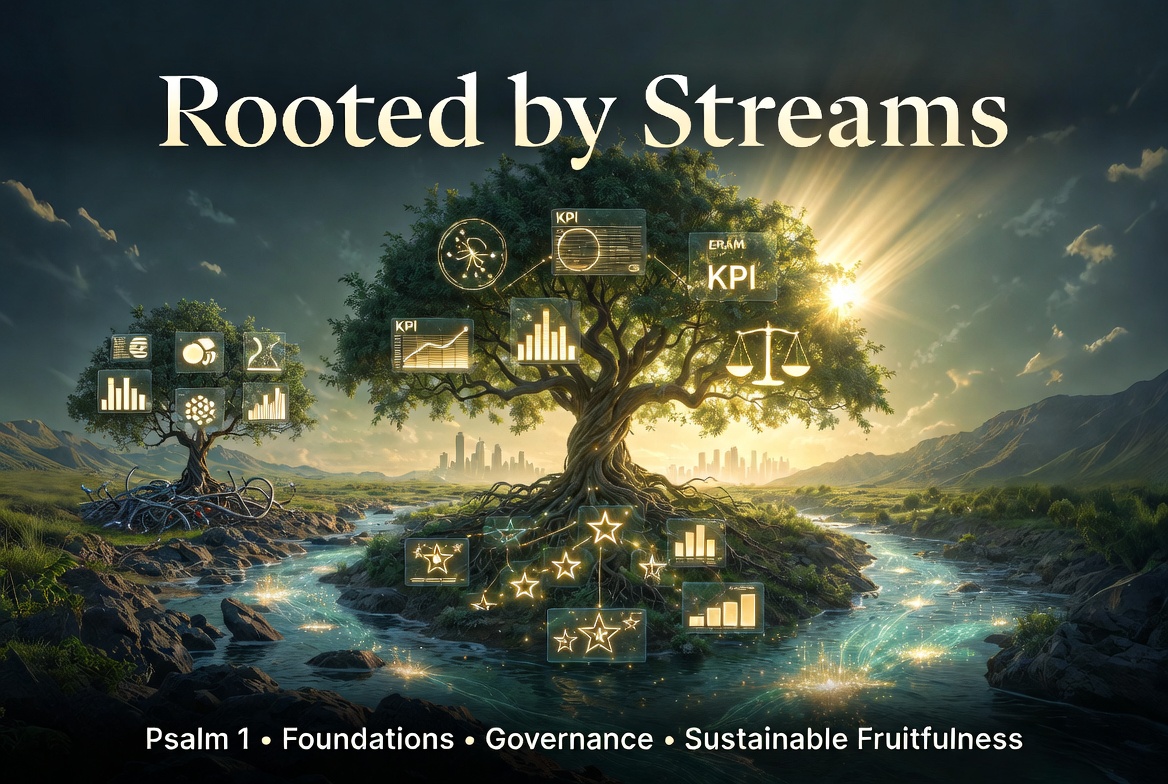
The Tree Planted by Streams of Water
Psalm 1 compares the wise person to “a tree planted by streams of water.”
This image is extraordinarily rich when applied to decision systems.
The tree represents the organization.
The roots represent foundational architecture.
The streams represent reliable information flow.
Healthy organizations are not sustained by random bursts of visibility.
They are sustained by continuous access to trustworthy information governed by disciplined structure.
Without streams:
• trees weaken
• leaves wither
• fruit disappears
Similarly, organizations without trustworthy information systems eventually experience:
• operational confusion
• declining trust
• KPI instability
• fragmented decision-making
The issue is not merely lack of data.
It is lack of rooted structure.
Manufacturing Example: Rooted Operational Systems
Consider a manufacturing company managing multiple production facilities.
One organization builds dashboards rapidly with inconsistent KPI definitions across plants.
Each facility calculates yield differently.
Operations teams interpret performance differently.
Executives lose confidence in reporting.
The organization becomes reactive.
Another organization invests early in:
• governance
• standardized grain
• aligned definitions
• validated transformations
At first, this approach may seem slower.
But over time, the organization becomes remarkably stable.
Decision-making improves.
Trust increases.
Operational alignment strengthens.
The organization becomes like a tree planted by streams.
Its structure sustains long-term fruitfulness.
CRM Example: Fruitfulness vs Vanity Metrics
Now consider a CRM environment.
One company becomes obsessed with lead volume metrics.
Dashboards show impressive growth.
Marketing celebrates rising numbers.
But customer quality declines.
Retention weakens.
Support costs increase.
The organization optimized vanity metrics instead of true business objectives.
Another organization builds its CRM decision systems around:
• customer lifetime value
• retention quality
• aligned definitions
• validated attribution models
Over time:
• customer trust improves
• revenue becomes healthier
• leadership confidence increases
This is the difference between temporary visibility and sustainable fruitfulness.
The Leaves Do Not Wither
Psalm 1 declares that the leaves of the wise tree “do not wither.”
In organizations, withering often appears as:
• declining trust
• reporting fatigue
• governance collapse
• KPI confusion
• operational instability
Many organizations experience this gradual decay because their systems lack deep roots.
Shortcuts accumulate.
Definitions drift.
Dashboards multiply.
Decision-making becomes reactive.
Eventually, leaders no longer trust the reporting environment.
But rooted organizations endure pressure differently.
Because disciplined architecture protects long-term stability.
This is why ERAM emphasizes:
• layered logic
• validation
• governance
• structural consistency
These principles create resilience.
Yielding Fruit in Its Season
Psalm 1 also emphasizes fruitfulness.
The wise tree “yields its fruit in season.”
In organizational terms, fruit represents the outcomes of wise decision systems:
• healthier growth
• stronger customer relationships
• increased profitability
• operational efficiency
• aligned leadership
• sustainable scaling
Importantly, fruit appears “in season.”
This reflects patience and maturity.
Wise organizations understand that sustainable success is built progressively through disciplined foundations.
Reactive organizations often chase immediate visibility while undermining long-term stability.
Wisdom prioritizes rootedness before acceleration.
Meditation and Organizational Imagination
One overlooked aspect of Psalm 1 is meditation.
Meditation implies continuous reflection and imagination shaped by principles.
In organizational life, this parallels leaders who intentionally evaluate:
• whether systems remain aligned with purpose
• whether KPIs still reflect mission
• whether governance remains healthy
• whether architecture still supports wise decisions
Wise organizations continually return to foundational questions.
They do not simply monitor dashboards.
They evaluate whether the system itself remains healthy.
This is one of the deepest dimensions of decision infrastructure.
Why Wisdom Matters More in the AI Era
Artificial intelligence is increasing organizational visibility dramatically.
But AI does not automatically create wisdom.
AI amplifies whatever structure already exists.
If the organization is rooted in:
• governance
• disciplined architecture
• aligned objectives
• trustworthy definitions
AI can enhance decision-making.
But if foundations are weak:
• confusion scales faster
• fragmented interpretation increases
• reactive behavior intensifies
This makes Psalm 1 more relevant than ever.
Because sustainable decision systems require deep roots before rapid scaling.
Conclusion: Rooted Organizations Produce Sustainable Fruit
Psalm 1 reveals a timeless truth about both people and organizations:
What sustains long-term fruitfulness is not temporary visibility.
It is rootedness.
Modern organizations often pursue:
• faster dashboards
• more KPIs
• more automation
• more reporting
while neglecting:
• governance
• alignment
• architectural discipline
• foundational wisdom
This is why so many reporting environments eventually become unstable.
The issue is not lack of data.
It is lack of rooted decision infrastructure.
The vision behind Eden Data Studio and ERAM is not simply building dashboards.
It is helping organizations become like the tree planted by streams of water:
• rooted in principles
• sustained by trustworthy information
• protected by disciplined structure
• capable of producing wise fruit consistently over time
Because when organizations delight in strong foundations, clarity becomes sustainable.
And sustainable clarity produces lasting success.
Previous Article: When good data leads to the wrong decision
Next Article: Joseph the steward who built a nation through wisdom, governance and decision infrastructure
Related Resources
Discover the Eden Reporting Architecture Method (ERAM) — a practical framework for building trusted decision infrastructure, KPI alignment, and scalable reporting systems.
Evaluate your reporting environment with an ERAM Audit and identify hidden risks related to KPI definitions, reporting trust, governance, and decision-making reliability.
