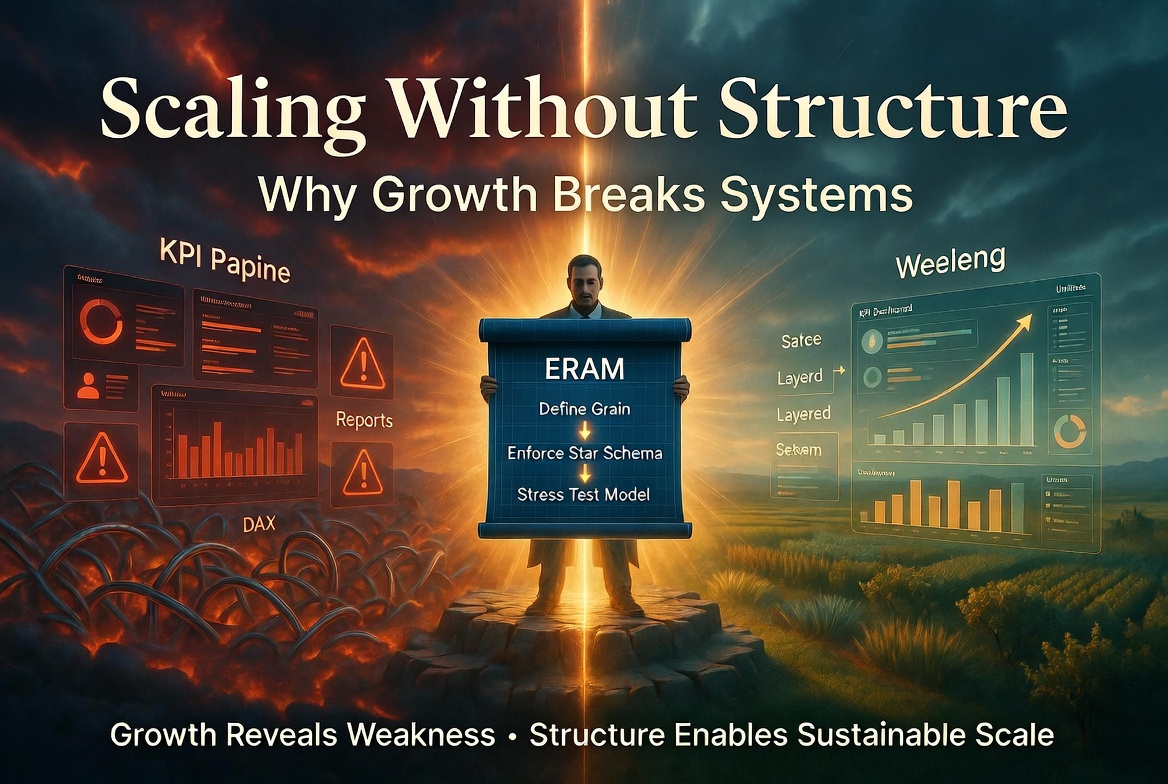
Scaling Without Structure: Why Growth Breaks Systems
Introduction: When Growth Becomes a Problem
Growth is often seen as the ultimate goal in business.
More revenue.
More customers.
More data.
It signals success.
But what many organizations discover—often too late—is that growth can also expose weaknesses.
Systems that once worked begin to fail.
Reports that once aligned start to diverge.
Dashboards that once seemed reliable become inconsistent.
This is not because growth is the problem.
It is because growth amplifies what already exists.
If structure is weak, growth will break it.
The Illusion of Early Success
In the early stages of a company, systems are simple.
Data volumes are low.
Teams are small.
Processes are informal.
At this stage, even poorly structured systems can appear to work.
A single dataset.
A few dashboards.
Minimal complexity.
Everything seems manageable.
But this simplicity is deceptive.
Because the system has not yet been tested.
When Growth Changes Everything
As organizations grow, complexity increases:
• More data sources
• More users
• More KPIs
• More reporting requirements
What once worked begins to strain under pressure.
Small inconsistencies become major issues.
Minor misalignments become critical failures.
And suddenly, the system that supported growth becomes the bottleneck.
Genesis Principle: Multiplication Requires Structure
In Genesis, multiplication comes after order.
“Be fruitful and multiply” is not given in chaos.
It is given after structure is established.
This sequence is critical.
Because multiplication without structure leads to disorder.
In business, growth is a form of multiplication.
And without structure, it creates instability.
The Hidden Weakness: Data Models Under Pressure
One of the first areas to break under growth is the data model.
In early stages, models are often built quickly:
• Tables are connected without clear logic
• Grain is not explicitly defined
• Relationships are inconsistent
• Business logic is embedded in multiple places
These shortcuts may work temporarily.
But as data volume and usage increase, they become critical issues.
Symptoms of Structural Weakness
As growth continues, the following symptoms appear:
• KPIs produce different results depending on context
• Reports take longer to load or fail
• Teams create separate versions of the same metric
• Analysts spend more time fixing than building
These are not performance issues.
They are structural issues.
Growth has simply revealed them.
Why Growth Exposes Weak Data Models
Growth introduces stress.
More data means more combinations.
More users mean more queries.
More complexity means more edge cases.
A well-structured model handles this stress predictably.
A weak model does not.
Instead, it produces:
• Inconsistent results
• Unexpected behavior
• Increasing maintenance effort
This is why growth is often the moment when trust in data begins to decline.
The ERAM Perspective: Structure Before Scale
The ERAM methodology is designed to prevent this failure.
It enforces a sequence that ensures systems are built for scale:
1. Define Business Objective
2. Define Grain
3. Transform Data
4. Enforce Star Schema
5. Build Layered DAX
6. Stress Test Model
7. Validate With Source
8. Design Dashboard
This sequence ensures that structure is established before growth occurs.
Because scalability is not added later.
It is designed from the beginning.
The Cost of Ignoring Structure
When organizations ignore structure during growth, the consequences are significant:
• Rebuilding data models from scratch
• Losing trust in reporting systems
• Slowing down decision-making
• Increasing operational costs
These costs are not always immediate.
But they compound over time.
Real-World Scenario
Consider a company that rapidly expands its operations.
New regions are added.
New products are introduced.
New systems are integrated.
Initially, reporting continues as usual.
But over time:
• Revenue numbers differ between systems
• Customer counts are inconsistent
• Performance metrics are questioned
The issue is not the growth itself.
It is that the underlying structure was never designed for scale.
From Fragility to Scalability
To support growth, systems must be resilient.
This requires:
• Clear data grain
• Consistent definitions
• Structured models
• Controlled logic
When these elements are in place:
Growth becomes manageable.
Systems scale predictably.
Trust is maintained.
Why Scaling Is a Structural Challenge
Scaling is not just about handling more data.
It is about maintaining consistency under increased complexity.
This is a structural challenge.
Not a technical one.
Because tools can process more data.
But they cannot fix unclear definitions or inconsistent models.
The Shift: Designing for Scale
Organizations must shift from reactive to proactive thinking:
From:
• Fixing issues after they appear
To:
• Designing systems that prevent issues
This means prioritizing structure early.
Even when growth is not yet visible.
Because by the time growth exposes problems…
It is often too late to fix them easily.
Genesis as a Framework for Growth
The Genesis sequence provides a clear model:
Order → Structure → Function → Multiplication
If multiplication comes before structure, systems break.
If structure comes first, growth is sustainable.
This principle applies directly to business systems.
Conclusion: Growth Reveals What Structure Hides
Growth does not create problems.
It reveals them.
If your data model is weak, growth will expose it.
If your structure is unclear, growth will amplify confusion.
But if your system is well-designed:
Growth becomes an opportunity.
Not a risk.
So before focusing on scaling your business:
Ask yourself:
Is your system ready for growth?
Because in the end:
You don’t scale systems by adding more data.
You scale systems by strengthening their structure.
If your organization is experiencing:
• Reporting inconsistencies as you grow
• Increasing complexity in data models
• Declining trust in dashboards
The issue may not be growth.
It may be structure.
Start there.
Everything else will follow.
Related Resources
Discover the Eden Reporting Architecture Method (ERAM) — a practical framework for building trusted decision infrastructure, KPI alignment, and scalable reporting systems.
Evaluate your reporting environment with an ERAM Audit and identify hidden risks related to KPI definitions, reporting trust, governance, and decision-making reliability.
