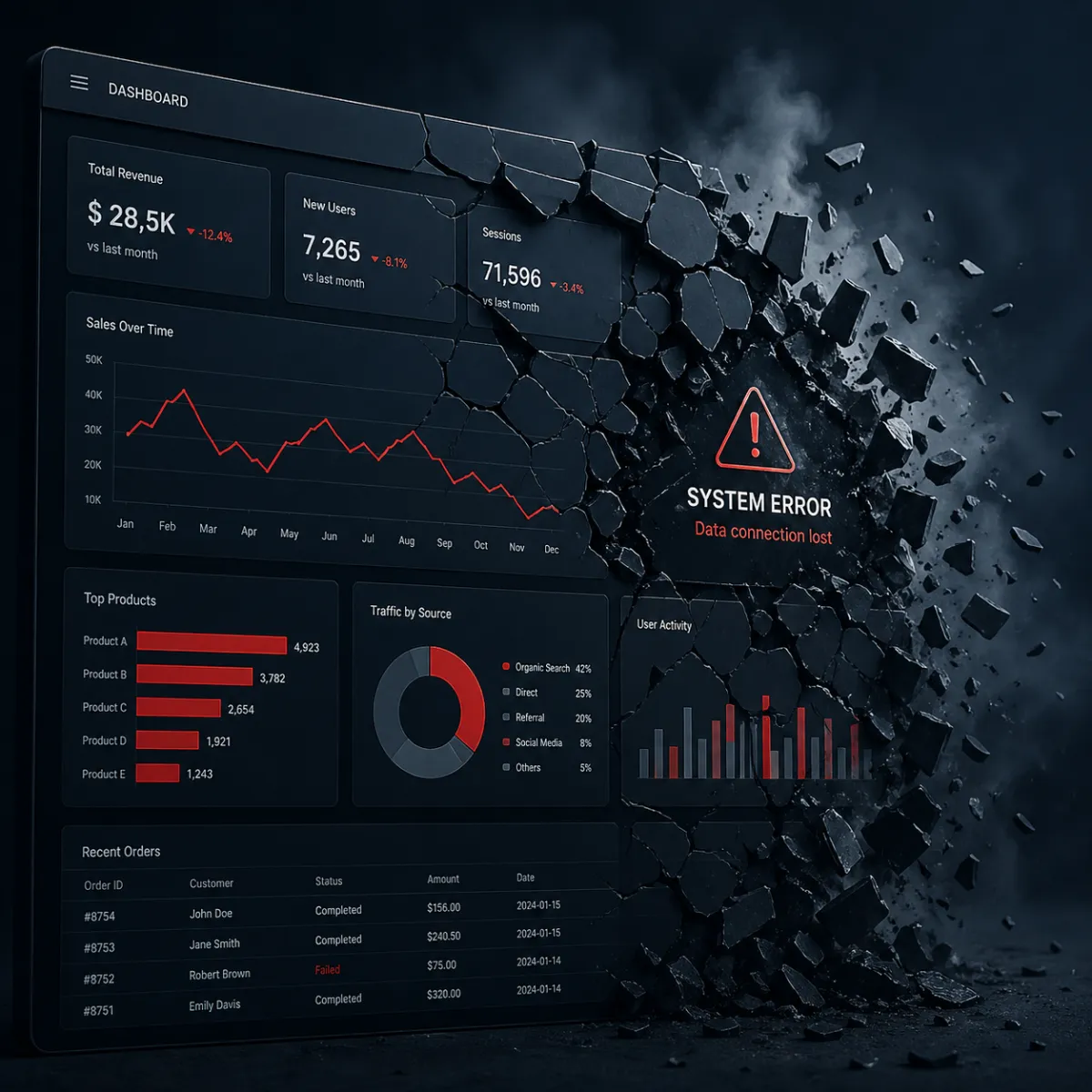
The Fall of Dashboards: What Happens When Structure Breaks
Introduction: When Dashboards Lose Trust
In the book of Genesis, there is a moment often referred to as “the fall.”
It represents a shift from order to disorder.
From clarity to confusion.
From alignment to fragmentation.
Things that once functioned naturally begin to break down.
This pattern is not only theological.
It is structural.
And in modern organizations, we see a similar “fall” happening in a different form:
The fall of dashboards.
Dashboards are meant to provide clarity.
They are designed to support decision-making.
They are supposed to represent truth.
But in many organizations, dashboards no longer serve that purpose.
Instead, they create confusion.
Numbers don’t match.
KPIs behave inconsistently.
Teams debate rather than decide.
This is not a visualization problem.
It is a structural breakdown.
The Promise of Dashboards
At their best, dashboards are powerful.
They bring together data from multiple sources.
They provide a single view of performance.
They enable faster, better decisions.
When built on a strong foundation, dashboards:
• Reflect accurate data
• Align teams around shared metrics
• Provide consistent answers to key questions
They become a trusted interface between data and decision-making.
But this only happens under one condition:
The underlying structure must be sound.
The Reality: When Dashboards Cannot Be Trusted
In many organizations, dashboards fail silently.
They do not crash.
They do not show obvious errors.
Instead, they produce something more dangerous:
Inconsistent truth.
Consider these common scenarios:
• A KPI changes depending on filters
• Two reports show different numbers for the same metric
• Finance and Operations disagree on results
• Users export data to Excel to “double-check”
These are warning signs.
They indicate that trust is eroding.
And once trust is lost, dashboards lose their purpose.
What Causes the Fall
The fall of dashboards does not happen suddenly.
It is the result of structural decisions made over time.
Common causes include:
• Undefined or inconsistent KPI definitions
• Mixing different levels of data (grain issues)
• Embedding business logic inside visuals
• Lack of clear data ownership
• Absence of governance and validation
Each of these may seem minor individually.
But together, they create instability.
And instability leads to breakdown.
The Illusion of Functionality
One of the most deceptive aspects of dashboard failure is that everything appears to work.
Charts render correctly.
Numbers are displayed.
Filters respond.
From a technical perspective, the system is functioning.
But from a decision-making perspective, it is broken.
Because functionality is not the same as reliability.
A dashboard can function perfectly…
And still be wrong.
Structure: The Hidden Foundation
Dashboards sit at the top of a system.
Beneath them lies:
• Data modeling
• Definitions
• Transformations
• Relationships
If these layers are weak, the dashboard cannot compensate.
It can only reflect the weakness.
This is why focusing on visuals alone rarely solves the problem.
Because visuals are the final layer.
Not the foundation.
The ERAM Perspective: Sequence Matters
The ERAM methodology emphasizes sequence:
1. Define Business Objective
2. Define Grain
3. Transform Data
4. Enforce Star Schema
5. Build Layered Logic
6. Stress Test Model
7. Validate With Source
8. Design Dashboard
Notice where dashboards appear.
At the end.
Not at the beginning.
This sequence ensures that by the time a dashboard is built:
• Data is structured
• Definitions are aligned
• Logic is controlled
• Outputs are validated
Without this sequence, dashboards become unstable.
When Structure Breaks, Everything Breaks
When structure breaks, the effects cascade:
• KPIs lose consistency
• Reports diverge
• Teams lose trust
• Decision-making slows
Over time, organizations compensate:
• They create more reports
• They build more dashboards
• They increase manual validation
But these are symptoms, not solutions.
The root cause remains:
Structural weakness.
From Trust to Skepticism
The most significant consequence of the fall of dashboards is not technical.
It is behavioral.
People stop trusting the system.
They begin to question every number.
They rely more on intuition than data.
They create parallel systems in Excel.
This shift is subtle but powerful.
Once trust is lost, it is difficult to regain.
Genesis as a Structural Warning
The fall in Genesis represents what happens when order is disrupted.
The same applies to business systems.
When structure is ignored:
• Clarity is lost
• Alignment breaks
• Systems degrade
Dashboards are simply the visible layer of this breakdown.
They reveal the fall.
How to Restore Trust
Restoring trust in dashboards requires going back to structure.
Not redesigning visuals.
Not adding more charts.
But addressing the foundation:
• Clarifying KPI definitions
• Establishing consistent grain
• Separating data, logic, and presentation
• Defining ownership
• Implementing validation processes
This is not a quick fix.
It is a structural correction.
From Dashboards to Decision Infrastructure
The goal is not better dashboards.
It is better decision infrastructure.
Dashboards should be:
• Reliable
• Consistent
• Trusted
They should not require validation.
They should not trigger debate.
They should enable action.
This only happens when structure is strong.
Conclusion: Build Before You Display
In a world focused on visuals, it is easy to prioritize dashboards.
But dashboards are not where clarity begins.
They are where clarity is revealed.
If the underlying system is strong, dashboards will be trusted.
If it is weak, dashboards will fail.
The lesson is simple:
Do not start with what you see.
Start with what supports it.
Because in the end:
A dashboard is only as reliable as the structure beneath it.
If your organization is experiencing:
• Dashboards that cannot be trusted
• Conflicting reports
• Slow decision-making
The issue may not be your tools.
It may be your structure.
Start there.
Everything else will follow.
Related Resources
Discover the Eden Reporting Architecture Method (ERAM) — a practical framework for building trusted decision infrastructure, KPI alignment, and scalable reporting systems.
Evaluate your reporting environment with an ERAM Audit and identify hidden risks related to KPI definitions, reporting trust, governance, and decision-making reliability.
