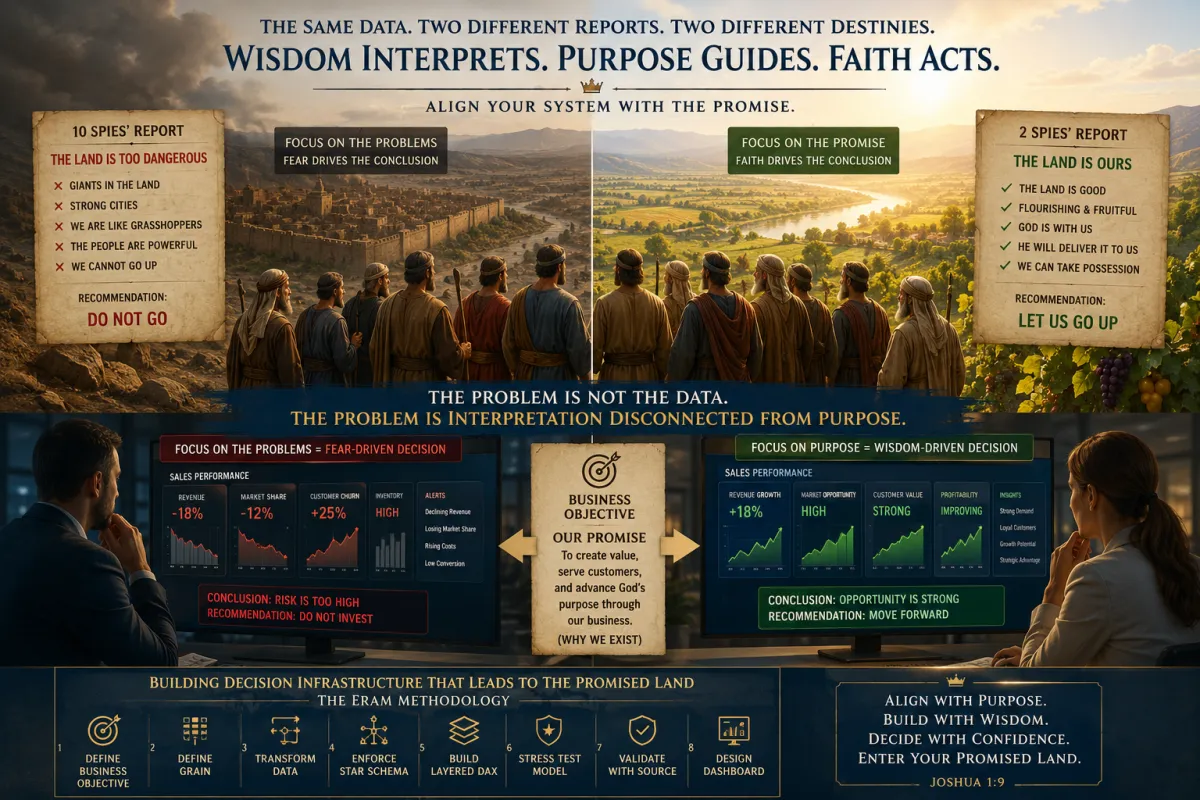
When Good Data Leads to the Wrong Decision
When Good Data Leads to the Wrong Decision: Biblical Wisdom and the Hidden Failure of Decision Systems
How the story of the Promised Land reveals timeless principles for business intelligence, leadership, and decision infrastructure.
Introduction: The Modern Crisis of Decision-Making
Modern organizations have more access to information than ever before.
Dashboards refresh continuously.
KPIs are tracked in real time.
AI-generated insights are expanding rapidly.
Executives receive more visibility than any generation before them.
Yet despite this unprecedented access to data, many organizations still struggle to make wise decisions.
Meetings become debates.
Teams interpret metrics differently.
Leaders lose confidence in reports.
Organizations react emotionally instead of strategically.
This reveals an important truth:
Good data alone does not guarantee good decisions.
And surprisingly, one of the clearest examples of this principle appears thousands of years ago in one of the most important stories of Scripture.
The story of Israel’s first failed entry into the Promised Land is not merely a historical account.
It is also a profound lesson about reporting, interpretation, leadership, and decision infrastructure.
For Christian business leaders, this story reveals something deeply important:
The greatest danger in decision-making is not always lack of information.
Sometimes the greatest danger is interpreting information without wisdom.
The Story: Twelve Spies, One Mission, Two Conclusions
As the people of Israel approached the land of Canaan, Moses instructed twelve leaders—one from each tribe—to survey the land.
Their assignment was clear:
Gather information.
Evaluate the territory.
Assess the situation.
In modern business language, we could say they were sent to perform strategic analysis.
And they succeeded technically.
They collected accurate observations:
• The land was fruitful
• The cities were fortified
• The inhabitants were strong
• Giants lived in the land
The data itself was not wrong.
But when the spies returned, something remarkable happened.
The same information produced two completely different conclusions.
Ten spies produced an alarming recommendation.
Their interpretation of the data led to fear, hesitation, and retreat.
Two spies—Joshua and Caleb—reached the opposite conclusion.
Not because they ignored the challenges.
But because they interpreted the information differently.
The Hidden Failure Was Not Data Collection
The failure was not the absence of information.
The failure was interpretation disconnected from the true objective.
The ten spies magnified one dimension of the situation:
the size of the opposition.
Their reporting emphasized fear.
Their analysis centered on obstacles.
Their interpretation disconnected the data from the original mission.
They neglected the defining objective that should have framed all interpretation:
God had already promised to lead them into the land.
Everything else should have been interpreted through that lens.
Instead, the objective disappeared from the reporting process.
And once the objective disappeared, fear became the dominant narrative.
The Business Parallel: When Organizations Lose the Objective
Modern organizations often make the same mistake.
Teams gather data accurately.
Dashboards display technically correct information.
KPIs appear sophisticated.
Yet decisions still fail.
Why?
Because information becomes disconnected from the true business objective.
Organizations frequently:
• optimize metrics instead of mission
• prioritize visibility instead of clarity
• magnify operational obstacles
• react emotionally to short-term fluctuations
The result is technically correct reporting environments that still produce poor strategic decisions.
This is one of the hidden crises of modern business intelligence.
Many organizations possess reporting systems.
Few possess true decision systems.
The ERAM Perspective: Why the Business Objective Comes First
This is one of the reasons the Eden Reporting Architecture Method—ERAM—begins with a foundational principle:
Define Business Objective.
Not dashboards.
Not KPIs.
Not visualizations.
The objective comes first because the objective determines how information should be interpreted.
Without this discipline:
• KPIs drift
• teams optimize conflicting priorities
• dashboards become fragmented
• decision-making becomes reactive
Joshua and Caleb interpreted the exact same information differently because they remained aligned with the original objective.
The ten spies focused primarily on the obstacles.
Joshua and Caleb focused on the mission and the promise.
Because reporting systems do not merely display information.
They shape organizational interpretation.
Good Data Can Still Produce Bad Decisions
One of the most dangerous assumptions in business is the belief that accurate reporting automatically creates wise decisions.
It does not.
Organizations can possess:
• accurate dashboards
• real-time analytics
• sophisticated KPIs
• advanced AI systems
and still make poor strategic decisions.
Because decision quality depends on:
• interpretation
• alignment
• governance
• context
• wisdom
The ten spies were not necessarily dishonest.
Their interpretation was simply disconnected from the foundational objective.
And once fear shaped the interpretation, the entire nation reacted emotionally.
The people decided to return to Egypt—the place of bondage—because fear became stronger than purpose.
When systems magnify fear instead of mission:
• innovation slows
• leaders become reactive
• departments protect themselves politically
• organizations retreat instead of advancing
The Danger of Magnifying the Wrong Dimension
One of the most striking aspects of the biblical account is how the ten spies disproportionately magnified one dimension of reality.
The giants became larger than the promise.
Organizations often magnify:
• temporary losses
• short-term volatility
• operational complexity
• isolated KPI fluctuations
while minimizing:
• long-term mission
• strategic positioning
• organizational strengths
• core objectives
When interpretation loses proportional balance, reporting environments begin driving fear instead of clarity.
This is why wisdom matters so deeply in business intelligence.
Wisdom determines:
• what receives emphasis
• what receives context
• what defines the narrative
Decision Infrastructure Is More Than Reporting
Many organizations believe dashboards themselves are decision systems.
But reporting and decision infrastructure are not the same thing.
Reporting answers:
“What happened?”
Decision infrastructure asks:
“How should the organization think and act?”
This requires:
• aligned definitions
• governance
• contextual understanding
• disciplined interpretation
• objective-centered architecture
This is why ERAM emphasizes structured sequence.
The methodology intentionally prioritizes:
1. Business objective alignment
2. Grain definition
3. Transformation discipline
4. Validation
5. Governance
before dashboard design.
Because visibility without wisdom can accelerate confusion instead of reducing it.
Manufacturing Example: The Fear-Driven KPI Culture
Consider a manufacturing organization experiencing temporary production inefficiencies.
Executives begin monitoring operational dashboards obsessively.
Short-term declines become the dominant narrative.
Managers react emotionally.
Departments begin protecting themselves.
Soon:
• teams optimize local KPIs instead of company objectives
• reporting becomes political
• decision-making slows
• innovation declines
The organization begins retreating strategically because operational fear dominates interpretation.
The issue is no longer the dashboard itself.
The issue becomes interpretation disconnected from mission.
CRM Example: Losing the Customer Objective
Now consider a CRM environment.
A company becomes obsessed with lead volume metrics.
Marketing increases lead generation aggressively.
Dashboards show impressive growth.
But customer quality declines.
Retention weakens.
Support costs rise.
The organization optimized the wrong dimension because the objective became distorted.
The dashboard was technically correct.
The decisions were strategically weak.
Again, the issue was not visibility.
It was interpretation disconnected from purpose.
Why Wisdom Matters More in the AI Era
Artificial intelligence is accelerating reporting environments dramatically.
Organizations now generate:
• predictive insights
• automated summaries
• conversational analytics
• real-time recommendations
But AI does not automatically create wisdom.
AI amplifies whatever interpretation framework already exists.
If the objective is unclear:
• confusion scales faster
• fragmented priorities expand
• fear-driven narratives spread more rapidly
This makes biblical wisdom even more important in modern business environments.
Because wisdom preserves alignment between information and mission.
The Leadership Responsibility
The ten spies shaped the emotional state of the entire nation.
Their interpretation influenced:
• morale
• direction
• confidence
• action
Leadership interpretation matters enormously.
In modern organizations:
• dashboards influence culture
• KPIs shape behavior
• reporting structures influence priorities
Leaders determine:
• what receives emphasis
• what defines success
• how information is interpreted
• whether fear or mission dominates organizational thinking
From Visibility to Wisdom
Many organizations today are visibility-rich but wisdom-poor.
They possess:
• massive reporting environments
• sophisticated analytics
• endless KPIs
But lack:
• alignment
• interpretation discipline
• objective-centered thinking
• governance
• structured decision-making
The solution is not simply more reporting.
The solution is wisdom-centered decision infrastructure.
This is the vision behind Eden Data Studio and the ERAM methodology.
Not merely building dashboards.
But helping organizations create systems where:
• information supports mission
• structure supports clarity
• reporting supports wise action
• decisions remain aligned with purpose
Conclusion: The Objective Must Govern the Interpretation
The story of the failed entry into the Promised Land reveals a timeless principle:
Good data interpreted without wisdom can still produce destructive decisions.
The ten spies and the two faithful spies saw the same land.
But one group interpreted reality through fear.
The other interpreted reality through purpose and promise.
This difference changed the future of an entire nation.
Modern organizations face the same challenge.
Dashboards alone are not enough.
Visibility alone is not enough.
Data alone is not enough.
Organizations need decision systems grounded in:
• wisdom
• structure
• governance
• alignment
• mission clarity
This is why the first step of ERAM remains so important:
Define Business Objective.
Because when the objective disappears from interpretation, even accurate information can lead organizations backward instead of forward.
But when information remains aligned with purpose, decision systems become instruments of clarity, confidence, and sustainable growth.
And that is where wisdom begins.
Previous Article: The cost of shortcuts in BI
Next Article: Rooted by streams: what Psalm1 reveals about decision systems
Related Resources
Discover the Eden Reporting Architecture Method (ERAM) — a practical framework for building trusted decision infrastructure, KPI alignment, and scalable reporting systems.
Evaluate your reporting environment with an ERAM Audit and identify hidden risks related to KPI definitions, reporting trust, governance, and decision-making reliability.
