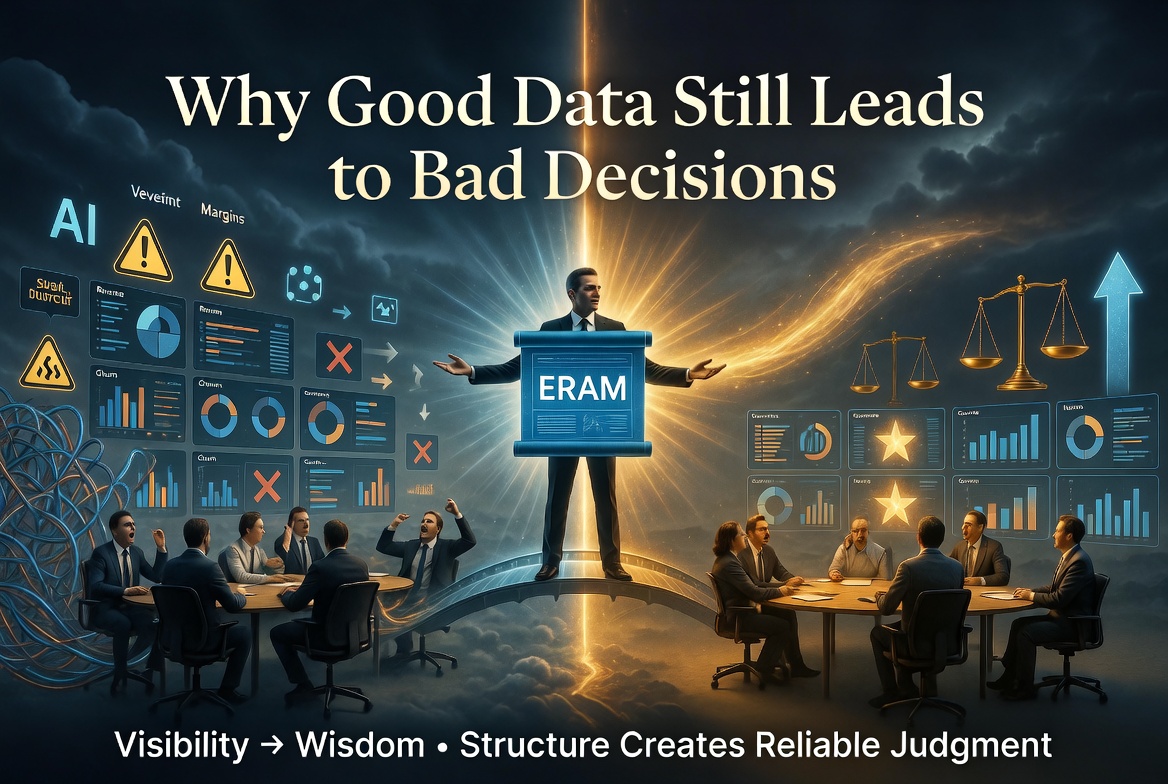
Why good data still leads to bad decision
Why Good Data Still Leads to Bad Decisions
Introduction: The Decision-Making Paradox
Modern organizations invest heavily in data.
They build dashboards.
Hire analysts.
Deploy AI tools.
Improve data quality.
Automate reporting.
Yet despite this growing sophistication, many organizations still make poor decisions.
Projects fail.
Strategies collapse.
Resources are misallocated.
Leadership reacts emotionally.
Teams lose alignment.
This creates an important question:
How can organizations possess good data and still make bad decisions?
The answer is simple but uncomfortable:
Good data alone does not guarantee good judgment.
This is one of the biggest misconceptions in modern business intelligence.
Organizations often assume that if the numbers are accurate, decisions will naturally improve.
But reality is far more complex.
Because decision quality depends on much more than data quality.
It depends on:
• interpretation
• governance
• priorities
• incentives
• organizational alignment
• context
• wisdom
This is why technically reliable reporting environments can still produce strategically poor outcomes.
The Visibility Illusion
Many organizations believe visibility automatically creates clarity.
The assumption seems logical:
If leaders can see the numbers, they should make better decisions.
But visibility and understanding are not the same thing.
A dashboard may accurately display:
• declining margins
• rising costs
• customer churn
• slowing growth
Yet leaders may still:
• misinterpret the cause
• prioritize the wrong response
• react emotionally
• optimize the wrong KPI
The data itself may be correct.
The decision still becomes flawed.
This reveals a critical truth:
Good data does not eliminate poor judgment.
The Difference Between Information and Decision-Making
Business intelligence systems are often optimized for information delivery.
But decision-making requires much more than information.
Information answers:
• What happened?
• How much?
• Where?
• When?
Decision-making requires:
• interpretation
• prioritization
• consequence awareness
• trade-off analysis
• contextual understanding
This is why two executives can review the same dashboard and arrive at completely different conclusions.
The data is identical.
The interpretation is not.
The Wisdom Principle: Data Does Not Replace Discernment
Biblical wisdom literature consistently emphasizes discernment and judgment.
Wisdom is never described as the accumulation of information alone.
Instead, wisdom involves:
• understanding consequences
• interpreting context
• recognizing priorities
• exercising disciplined judgment
This principle applies directly to modern decision support systems.
Organizations frequently believe that increasing visibility automatically reduces decision risk.
But more information can also create:
• analysis paralysis
• emotional overreaction
• KPI obsession
• short-term thinking
Without wisdom, visibility can amplify confusion instead of reducing it.
The ERAM Perspective: Reliable Decisions Require Reliable Structure
The ERAM methodology is deeply connected to this principle.
ERAM is not simply about creating dashboards.
It is about building structured environments that support reliable decisions.
This is why ERAM follows a disciplined sequence:
1. Define Business Objective
2. Define Grain
3. Transform Data
4. Enforce Star Schema
5. Build Layered DAX
6. Stress Test Model
7. Validate With Source
8. Design Dashboard
Notice an important pattern.
The methodology spends most of its effort strengthening architecture before visualization.
Why?
Because decision quality depends heavily on structural reliability.
If:
• business objectives are unclear
• grain is inconsistent
• transformations distort meaning
• KPI definitions drift
then even accurate dashboards can support poor decisions.
This is one of the hidden realities of reporting architecture:
Good visuals cannot compensate for weak organizational understanding.
The KPI Trap
One of the most common causes of poor decisions is KPI misalignment.
Organizations often become obsessed with measuring performance while failing to align on what success actually means.
For example:
• Sales prioritizes revenue growth
• Finance prioritizes margin protection
• Operations prioritizes efficiency
Each department may possess accurate data.
Yet if priorities conflict, decision-making becomes fragmented.
The issue is no longer data quality.
It becomes:
• governance
• alignment
• strategic clarity
This explains why many organizations possess excellent reporting environments while still struggling operationally.
Why Speed Increases Bad Decisions
Modern BI environments increasingly prioritize speed.
Real-time reporting.
Instant notifications.
Automated insights.
AI-generated summaries.
These tools are powerful.
But speed can also amplify poor judgment.
Why?
Because faster visibility does not automatically improve interpretation.
Organizations often react to:
• temporary fluctuations
• incomplete trends
• isolated anomalies
without understanding the broader context.
This creates reactive decision cultures.
And reactive cultures frequently produce unstable organizations.
Wisdom slows interpretation long enough to preserve clarity.
The Organizational Politics Problem
One of the least discussed dimensions of bad decision-making is organizational politics.
Data does not exist in isolation.
Metrics influence:
• budgets
• leadership credibility
• team performance
• strategic priorities
As a result, organizations sometimes unconsciously distort interpretation to protect:
• incentives
• reputations
• departmental interests
This creates a dangerous situation where:
• the data is technically accurate
• but organizational interpretation becomes biased
Good data still leads to bad decisions because incentives shape perception.
This is why governance matters so deeply.
Reliable decision systems require:
• accountability
• shared definitions
• transparent logic
• aligned objectives
---
The Grain Problem and Decision Distortion
One of the most underestimated causes of poor decisions is improper grain definition.
ERAM emphasizes grain early because grain determines how information behaves across the entire model.
If grain is inconsistent:
• aggregations become unstable
• comparisons lose meaning
• KPIs behave unpredictably
Many organizations attempt to solve these issues through:
• more calculations
• more transformations
• more dashboards
But complexity cannot solve foundational ambiguity.
Leaders may confidently make decisions using reports built on unstable logic.
The data appears accurate.
The interpretation becomes distorted.
Why AI Does Not Automatically Improve Decisions
Artificial intelligence is transforming reporting environments rapidly.
Organizations now generate:
• predictive analytics
• automated narratives
• anomaly detection
• conversational reporting
But AI does not replace wisdom.
AI scales information.
It does not inherently scale judgment.
If organizations lack:
• governance
• alignment
• structural discipline
• contextual understanding
AI can accelerate poor decisions faster than humans alone.
This is one of the most important challenges emerging in modern analytics environments.
The stronger automation becomes, the more important architectural wisdom becomes.
The Difference Between Reporting and Decision Systems
Many organizations believe dashboards themselves are decision systems.
But reporting and decision support are not identical.
Reporting provides visibility.
Decision systems support judgment.
A mature decision system requires:
• trusted architecture
• aligned metrics
• contextual interpretation
• governance discipline
• consequence awareness
Without these layers, organizations may possess excellent reporting while still making inconsistent decisions.
This is why decision quality cannot be measured only by dashboard sophistication.
Why Strong Organizations Prioritize Calm Interpretation
One characteristic of mature organizations is calmness.
Strong decision systems reduce:
• emotional reactions
• KPI panic
• executive overcorrection
• operational instability
Why?
Because trusted structure creates confidence.
When leaders trust:
• definitions
• governance
• ownership
• architecture
they spend less time debating information and more time evaluating consequences.
This creates wiser decision-making environments.
From Visibility to Understanding
One of the most important evolutions in modern BI is shifting from visibility toward organizational understanding.
Visibility shows data.
Understanding explains meaning.
Wisdom guides action.
This progression matters enormously.
Because organizations rarely fail from lack of information.
They fail from:
• fragmented interpretation
• weak governance
• conflicting priorities
• reactive behavior
• poor structural discipline
---
Conclusion: Good Data Alone Cannot Guarantee Good Decisions
Modern organizations often assume that accurate reporting environments automatically create good decisions.
But good data alone is not enough.
Reliable decision-making requires:
• aligned objectives
• structured interpretation
• governance
• contextual understanding
• architectural discipline
• wisdom
This is why ERAM prioritizes structure before visibility.
Because dashboards alone cannot guarantee organizational clarity.
The goal of business intelligence is not simply producing accurate reports.
It is supporting reliable decisions.
And reliable decisions require more than good data.
They require understanding, alignment, and wisdom.
If your organization experiences:
• KPI conflicts
• reactive leadership decisions
• dashboard mistrust
• reporting overload
• operational confusion
The issue may not be data quality.
It may be the absence of structured decision architecture.
And strong decision systems require more than visibility.
They require wisdom.
