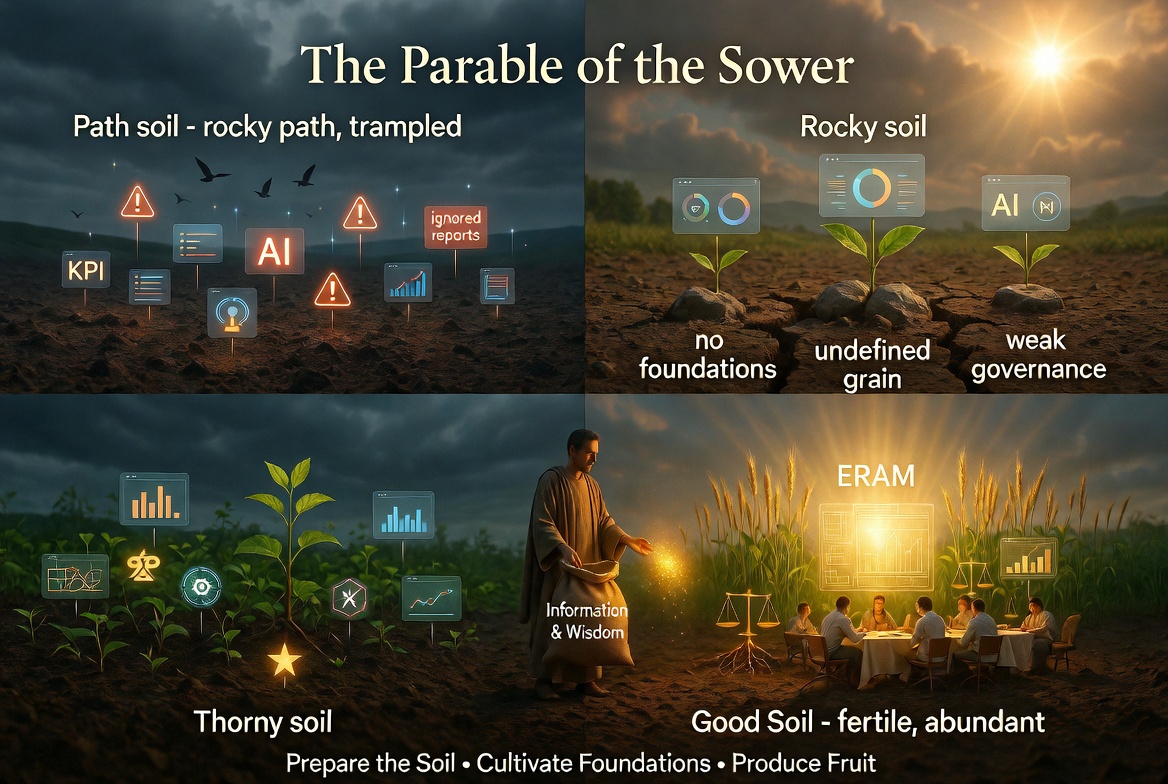
Why Some Decision Systems Produce Fruit and Others Fail
The Parable of the Sower: Why Some Decision Systems Produce Fruit and Others Fail
Introduction: Why Similar Organizations Produce Different Results
Two organizations can invest in the same technologies.
Both can purchase modern BI platforms.
Both can deploy AI tools.
Both can hire analysts.
Both can build dashboards.
Yet years later, one organization produces trusted decisions, sustainable growth, and operational excellence.
The other struggles with confusion, mistrust, KPI conflicts, and reactive leadership.
Why?
The Parable of the Sower provides a profound answer.
Although Jesus used this story to describe spiritual truth, it also reveals timeless principles about foundations, discipline, stewardship, and fruitfulness.
When viewed through the lens of decision infrastructure, the four soils become a powerful model for understanding why some reporting systems produce lasting value while others never reach maturity.
The Seed: Information, Insight, and Truth
In the parable, the seed remains the same.
The difference is not the seed.
The difference is the condition of the soil receiving it.
This mirrors modern organizations.
The problem is rarely lack of data.
Most organizations already possess:
• dashboards
• KPIs
• reports
• analytics
• AI-generated insights
The question is not whether information exists.
The question is whether the organization has the structure necessary to transform information into fruit.
In business terms, fruit represents:
• wise decisions
• profitable growth
• operational excellence
• customer loyalty
• organizational alignment
The Path: Information Without Reception
The first seed falls on the path and is quickly removed.
In organizations, this represents information that never truly enters decision-making.
Executives request reports but ignore them.
Teams collect data but never act on it.
Lessons from previous failures are forgotten.
Organizations in this category often suffer from visibility overload.
Reports are produced continuously.
Yet nobody changes behavior.
Even the best dashboard cannot create value if the organization refuses to receive the information.
ERAM begins with Define Business Objective precisely to prevent this problem.
Without a clear objective, information becomes noise.
Rocky Soil: Excitement Without Foundation
The second soil receives the seed quickly.
Growth appears immediately.
But because roots are shallow, the plant cannot survive pressure.
This is one of the most common patterns in modern BI initiatives.
Organizations become excited about:
• AI
• dashboards
• predictive analytics
• self-service reporting
Projects launch rapidly.
Executive sponsorship is strong.
Early demonstrations look impressive.
But foundational work is neglected.
Examples include:
• undefined business objectives
• weak grain definition
• inconsistent KPIs
• poor governance
Initially everything appears successful.
Then pressure arrives.
Performance problems emerge.
Trust declines.
Definitions conflict.
The initiative struggles because visibility was built before roots.
This is why ERAM emphasizes:
1. Define Business Objective
2. Define Grain
before any dashboard design.
Roots must come before growth.
The Thorny Soil: The Great Enemy of Modern Decision Systems
The third soil may be the most relevant for modern organizations.
The seed grows.
But competing influences choke the plant before it can become fruitful.
Jesus identifies distractions, worries, and competing priorities as the cause.
In today's organizations, AI can unintentionally become a modern version of these thorns.
AI itself is not the problem.
The problem is lack of discipline.
Organizations now face:
• unlimited information
• endless recommendations
• constant alerts
• AI-generated reports
• automated insights
Without governance, leaders become overwhelmed.
Information multiplies faster than wisdom.
The result is decision fatigue.
The organization becomes distracted rather than focused.
How AI Can Harm Each ERAM Step
Step 1: Define Business Objective
AI can generate hundreds of ideas.
Without discipline, teams pursue interesting insights rather than strategic objectives.
The objective becomes fragmented.
Step 2: Define Grain
AI may produce outputs without understanding business grain.
Leaders trust results they do not fully understand.
Inconsistent detail levels create confusion.
Step 3: Transform Data
AI can automate transformations rapidly.
But poorly governed transformations scale errors.
Step 4: Enforce Star Schema
AI may generate technically functional models that violate long-term architectural principles.
Short-term convenience replaces scalability.
Step 5: Build Layered DAX
AI often encourages quick solutions.
Organizations accumulate technical debt disguised as productivity.
Step 6: Stress Test Model
Teams trust AI outputs without challenging assumptions.
Weaknesses remain hidden.
Step 7: Validate With Source
One of the biggest risks.
AI-generated outputs can appear authoritative while being incorrect.
Validation becomes more important than ever.
Step 8: Design Dashboard
AI can generate beautiful dashboards quickly.
But beautiful dashboards are not necessarily trustworthy dashboards.
Without disciplined foundations, visibility merely accelerates confusion.
The thorny soil teaches an important lesson.
More information does not guarantee more fruit.
Sometimes more information simply creates more distraction.
The Good Soil: Decision Infrastructure That Produces Fruit
The fourth soil receives the seed and produces abundant fruit.
This represents organizations that combine information with wisdom, discipline, and structure.
These organizations understand:
·Data alone is not enough.
·AI alone is not enough.
·Dashboards alone are not enough.
·Fruit requires foundations.
This is exactly what ERAM seeks to create.
Organizations that:
• define objectives clearly
• govern consistently
• validate rigorously
• build scalable architecture
• maintain disciplined interpretation
·create environments where information can flourish.
Manufacturing Example
Consider two manufacturing companies.
Both invest in advanced analytics.
The first company rushes implementation.
Every plant defines KPIs differently.
AI generates recommendations continuously.
Executives become overwhelmed.
Trust declines.
The second company establishes:
• common definitions
• governance standards
• validation processes
• standardized grain
The technology is similar.
The outcomes are completely different.
One system becomes thorny soil.
The other becomes good soil.
CRM Example
Now consider CRM analytics.
One organization deploys AI-driven forecasting immediately.
Every department uses different customer definitions.
Revenue attribution varies widely.
AI accelerates confusion.
Another organization first establishes:
• customer definitions
• attribution governance
• trusted calculations
• validation standards
Only then is AI introduced.
The same technology produces dramatically different outcomes because the soil is different.
Fruitfulness Is the Goal
One of the most important observations from the parable is that growth alone is not the objective.
Fruit is.
Many organizations mistake activity for success.
More dashboards.
More reports.
More metrics.
More AI.
But fruit is the real measure.
Fruit appears as:
• better decisions
• stronger trust
• healthier growth
• operational excellence
• customer satisfaction
The goal of decision infrastructure is not visibility.
It is fruitfulness.
Wisdom Creates the Soil
The parable ultimately teaches that outcomes are determined by conditions.
Organizations cannot control every market force.
They cannot eliminate uncertainty.
But they can cultivate the soil.
They can choose:
• governance over chaos
• discipline over distraction
• validation over assumption
• architecture over shortcuts
This is where wisdom enters the picture.
Wisdom prepares the environment where truth can flourish.
Conclusion: Prepare the Soil Before Seeking More Seed
Many organizations believe their biggest challenge is obtaining more information.
The Parable of the Sower suggests otherwise.
The issue is often not the seed.
The issue is the soil.
Organizations that ignore foundations become:
• distracted
• reactive
• overwhelmed
Organizations that cultivate strong decision infrastructure become:
• aligned
• resilient
• fruitful
The vision behind ERAM is not merely creating dashboards.
It is preparing the soil.
Because when governance, stewardship, validation, and wisdom become part of organizational culture, information can finally produce its intended fruit.
And that fruit becomes sustainable success.
Previous Article: Joseph the steward who built a nation through wisdom, governance and decision infrastructure
Next Article: Discipline before speed in reporting
Related Resources
Dashboards are not infrastructure
Discover the Eden Reporting Architecture Method (ERAM) — a practical framework for building trusted decision infrastructure, KPI alignment, and scalable reporting systems.
Evaluate your reporting environment with an ERAM Audit and identify hidden risks related to KPI definitions, reporting trust, governance, and decision-making reliability.
