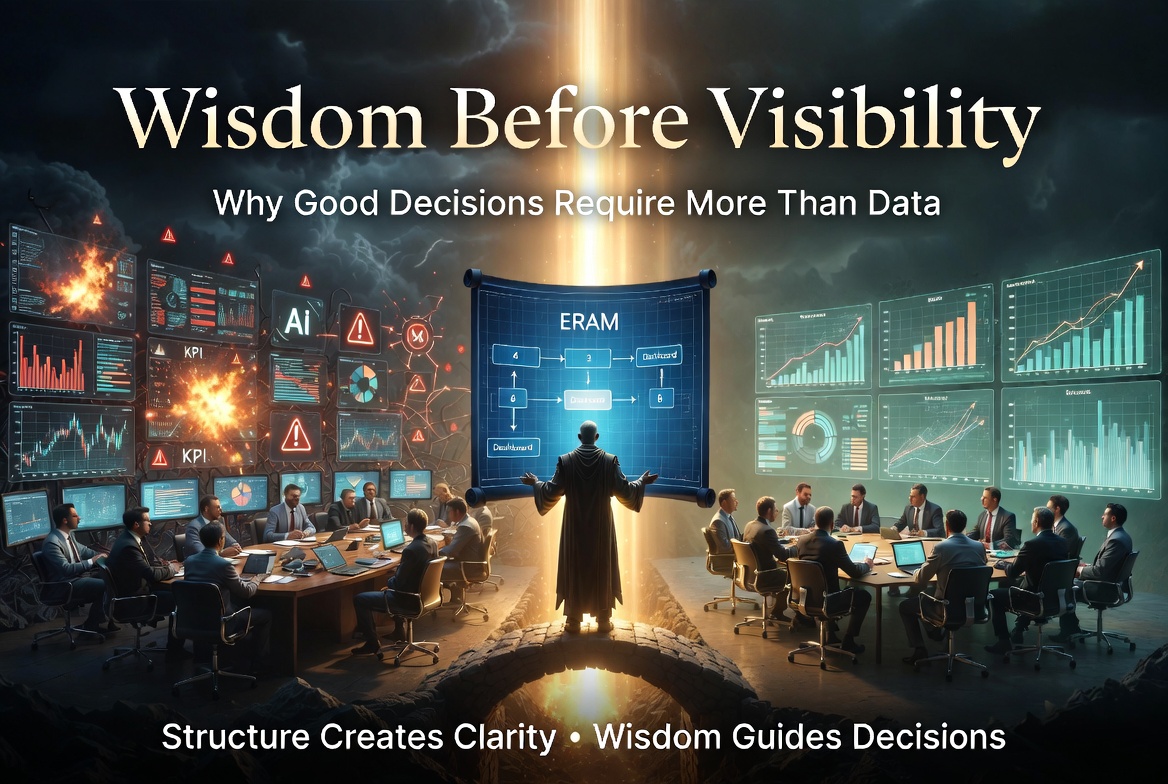
Wisdom Before Visibility: Why Good Decisions Require More Than Data
Introduction: The Information Illusion
Modern organizations have more information than ever before. Dashboards update in real time, KPIs are tracked continuously, and reports can be generated in seconds. Yet despite this abundance of visibility, many organizations still struggle to make good decisions.
Meetings become longer instead of shorter. Teams debate metrics instead of acting on them. Executives question reports instead of trusting them.
This reveals a critical truth: information alone does not create wisdom.
In biblical literature, especially in Proverbs, wisdom is consistently presented as something deeper than knowledge. Knowledge gathers facts. Wisdom interprets them correctly. Knowledge explains what is happening. Wisdom understands what should happen next.
This distinction is profoundly relevant in modern reporting systems because many organizations are building visibility systems when what they truly need are wisdom systems.
The Modern Obsession With Visibility
Most organizations believe that more visibility automatically leads to better decisions. The assumption seems logical:
More dashboards → More insight → Better outcomes.
But reality is more complicated.
Visibility without interpretation often creates noise instead of clarity. Executives receive dozens of KPIs. Managers track hundreds of metrics. Teams monitor every operational fluctuation. Yet decision quality frequently declines.
Why?
Because information increases faster than understanding.
Organizations can become data-rich while remaining wisdom-poor.
Knowledge vs Wisdom in Business Systems
Knowledge and wisdom are not the same.
Knowledge answers:
• What happened?
• How much?
• Where?
• When?
Wisdom asks:
• Why did this happen?
• What are the implications?
• What should we prioritize?
• What trade-offs exist?
• What decision creates the best long-term outcome?
A dashboard can display declining margins. But wisdom interprets whether the decline is temporary or structural, whether it results from pricing strategy or operational inefficiency, and whether protecting volume or margin is strategically wiser.
This is why dashboards alone cannot replace judgment. Visibility is not wisdom.
The Proverbs Principle: Wisdom Requires Structure
The book of Proverbs repeatedly connects wisdom with discipline, order, and understanding. Wisdom is not described as randomness or speed. It is described as disciplined thinking, careful interpretation, and sound judgment.
The same principle applies to reporting architecture.
Weak systems produce reactive decisions. Strong systems support wise decisions.
When reporting environments are chaotic:
• KPIs conflict
• Logic becomes fragmented
• Reports behave unpredictably
• Trust declines
In such environments, leaders spend more time validating information than using it. This reduces organizational wisdom because energy shifts from interpretation to verification.
The ERAM Perspective: Building Systems That Support Wisdom
The ERAM methodology is fundamentally aligned with this principle. Its purpose is not merely to build dashboards. Its purpose is to build structured decision infrastructure.
The 8-step ERAM methodology follows a disciplined sequence:
1. Define Business Objective
2. Define Grain
3. Transform Data
4. Enforce Star Schema
5. Build Layered DAX
6. Stress Test Model
7. Validate With Source
8. Design Dashboard
Notice something important: the dashboard comes last.
Because visibility without structure creates illusion.
ERAM prioritizes architectural clarity before presentation. Instead of asking “How quickly can we build a dashboard?” ERAM asks “How do we create a reliable environment for decision-making?”
That is a wisdom question.
Why Many Dashboards Create Confusion
One of the biggest misconceptions in BI is the belief that more reporting automatically improves organizations. But poorly structured visibility often amplifies confusion.
Examples include:
• Multiple departments tracking the same KPI differently
• Executives receiving conflicting reports
• Dashboards producing inconsistent outputs under filters
• Analysts spending hours explaining numbers instead of interpreting them
In these situations, visibility increases while wisdom decreases because wisdom requires consistency, and consistency requires structure.
The Difference Between Fast Decisions and Wise Decisions
Modern organizations value speed. Real-time dashboards, instant alerts, and automated reporting tools are valuable. But speed alone is not wisdom.
A fast wrong decision is still a wrong decision.
Organizations often optimize decision velocity before ensuring decision quality. Proverbs repeatedly warns against impulsive judgment. Wisdom pauses, evaluates, interprets, and understands consequences.
This does not mean organizations should become slow. It means they should become structured because structure enables both speed and reliability.
Grain: The Hidden Foundation of Wise Reporting
One of the most powerful examples of wisdom in ERAM is grain definition. Grain defines what a single row represents:
·Transaction?
·Order?
·Daily summary?
·Customer snapshot?
If grain is unclear:
• Aggregations become unstable
• Filters behave unpredictably
• KPIs lose consistency
Many organizations attempt to solve these problems with increasingly complex DAX. But complexity cannot compensate for unclear structure.
Wisdom recognizes that foundational clarity matters more than reactive fixes.
This is why ERAM begins with definition before calculation.
Wisdom vs Technical Brilliance
Intelligence and wisdom are not identical. An analyst may write advanced DAX formulas and still create unstable reporting systems.
Why?
Because technical brilliance without structural discipline creates fragility.
Wisdom asks:
• Will this scale?
• Will this remain understandable?
• Can another analyst maintain this?
• Will executives trust these outputs?
These questions reflect architectural thinking. Architectural thinking transforms analysts into advisors.
The Leadership Dimension of Wisdom
In organizations, wisdom is not only a technical issue. It is a leadership issue.
Leaders influence:
• KPI priorities
• Reporting culture
• Governance discipline
• Accountability standards
When leadership values visibility over clarity:
• Dashboards multiply
• Definitions drift
• Reporting becomes political
When leadership values wisdom:
• Definitions align
• Structure is prioritized
• Governance improves
• Decision quality increases
This is why reporting architecture cannot be separated from organizational culture. Systems reflect leadership priorities.
Real-World Example: Revenue Growth Confusion
Consider a company tracking revenue growth across Finance, Sales, and Operations.
Sales calculates growth using booked contracts.
Finance uses recognized revenue.
Operations tracks delivered value.
All three departments present “growth” dashboards. Each report is technically correct. Yet leadership meetings become debates.
Why?
Because knowledge exists without shared wisdom.
The organization has visibility but lacks aligned understanding.
A wisdom-driven approach would begin differently. Before building dashboards, the organization would:
• Align KPI definitions
• Document assumptions
• Establish ownership
• Validate calculations
This discipline is deeply embedded within ERAM.
Why Wisdom Scales Better Than Complexity
Many organizations attempt to solve reporting problems by adding more dashboards, more alerts, more tools, and more calculations. But complexity rarely creates clarity.
Wisdom simplifies.
Strong systems often appear simpler because definitions are aligned, logic is centralized, relationships are predictable, and responsibilities are clear.
This simplicity is not weakness. It is maturity.
Stable systems support sustainable decisions. Chaotic systems create reactive organizations.
From Reporting to Decision Architecture
One of the most important shifts in modern BI is moving from reporting toward decision architecture.
Reporting asks:
“What happened?”
Decision architecture asks:
“How should the organization think and act?”
This shift requires:
• Structure
• Governance
• Interpretation
• Alignment
• Contextual understanding
In other words, it requires wisdom.
The Danger of AI Without Wisdom
Artificial intelligence is accelerating visibility dramatically. Organizations can now generate automated reports, predictive insights, conversational analytics, and AI-generated summaries.
But AI does not replace wisdom.
AI scales information. It does not inherently scale judgment.
If the underlying architecture is weak:
• AI amplifies inconsistencies
• Poor definitions spread faster
• Misleading insights scale more broadly
This is why wisdom becomes even more important in the AI era. Structure must precede automation. Clarity must precede acceleration.
Conclusion: Build Systems That Support Wisdom
Modern organizations do not primarily suffer from lack of data. They suffer from lack of structured understanding.
Dashboards alone cannot solve this.
More KPIs cannot solve this.
More visibility cannot solve this.
What organizations truly need are systems that support wise decision-making.
This requires:
• Clear definitions
• Disciplined architecture
• Aligned metrics
• Validated logic
• Structured governance
The ERAM methodology reflects this philosophy deeply. It recognizes that dashboards are not the goal. Reliable decisions are.
The lesson from Proverbs remains timeless:
Wisdom is more valuable than information.
And in business intelligence, wisdom begins with structure.
If your organization is experiencing:
• KPI conflicts
• Dashboard confusion
• Lack of trust in reporting
• Slow or reactive decisions
The issue may not be visibility.
It may be wisdom.
And wisdom begins with structure.
Previous Article: Creation to multiplication
Next Article : knowledge is not enough
Related Resources
Discover the Eden Reporting Architecture Method (ERAM) — a practical framework for building trusted decision infrastructure, KPI alignment, and scalable reporting systems.
Evaluate your reporting environment with an ERAM Audit and identify hidden risks related to KPI definitions, reporting trust, governance, and decision-making reliability.
P
