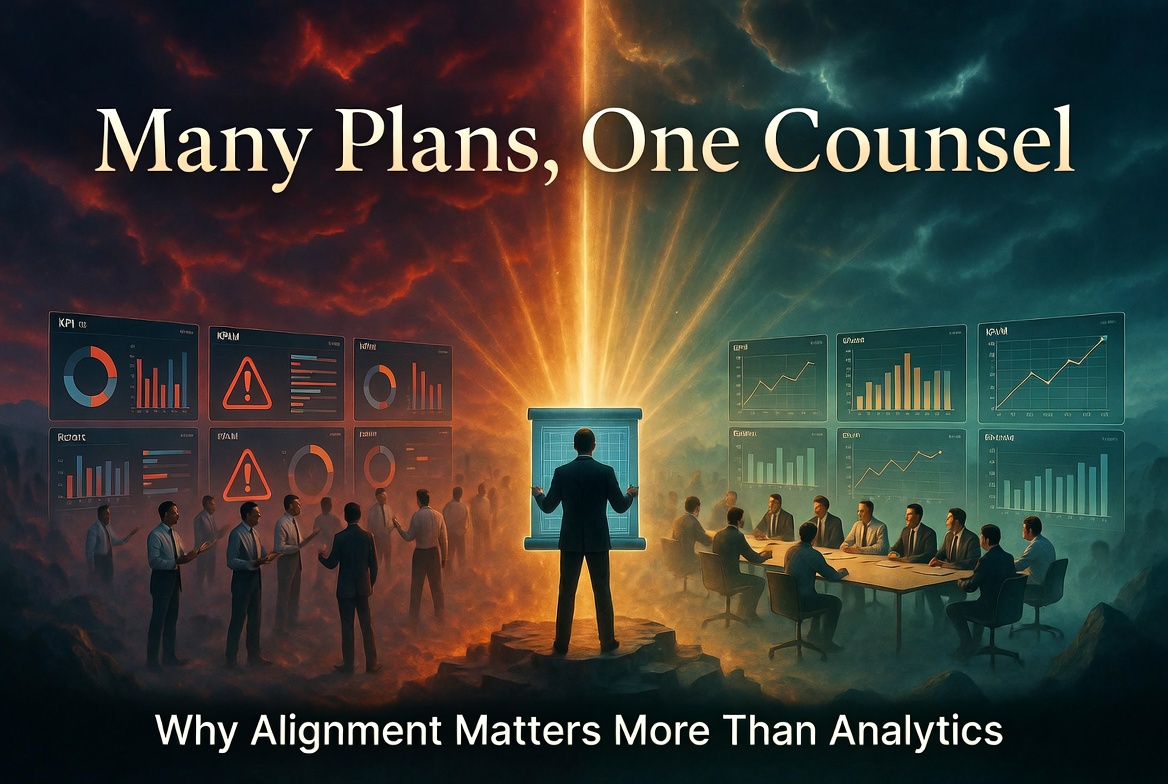
Many plans, one counsel
Many Plans, One Counsel – Why Alignment Matters More Than Analytics
“Plans fail for lack of counsel, but with many advisers they succeed.” — Proverbs 15:22
Introduction: The Most Expensive Reporting Problem
Organizations often assume their reporting problems are technical.
They invest in new dashboards.
New BI platforms.
New AI tools.
New reporting teams.
Yet one of the most expensive reporting failures has very little to do with technology.
It is misalignment.
Different departments define the same KPI differently.
Regional offices measure performance differently.
Executives receive conflicting versions of the truth.
Reports become debates rather than decision-support tools.
The result is surprisingly costly.
Time is lost.
Trust declines.
Decisions slow down.
And the organization discovers a painful reality:
Alignment matters more than analytics.
The Hidden Cost of Misalignment
Many organizations focus on data quality.
Far fewer focus on definition quality.
Yet some of the most damaging reporting failures occur when the data itself is accurate.
The problem is that people disagree about what the numbers mean.
A sales metric appears correct.
Marketing disputes the definition.
Finance calculates it differently.
Operations interprets it differently again.
Everyone possesses data.
Nobody possesses alignment.
The dashboard becomes a battlefield.
The KPI becomes a source of conflict.
Decision-making becomes slower despite increasing investments in reporting.
Why Alignment Is a Wisdom Problem
Alignment is often viewed as a governance challenge.
It is actually a wisdom challenge.
Wisdom creates shared understanding.
Shared understanding creates alignment.
Alignment creates trust.
Trust enables decisions.
This progression appears repeatedly throughout Scripture.
Many plans may exist.
Many perspectives may exist.
Many opinions may exist.
Yet successful outcomes require unified understanding.
The same principle applies to reporting architecture.
The Problem With Multiple Versions of Truth
One of the most common symptoms of reporting failure is the emergence of multiple versions of truth.
Different teams build different reports.
Different departments create alternative calculations.
Different regions maintain separate definitions.
Initially these differences appear manageable.
Over time they become destructive.
Executives spend increasing amounts of time reconciling numbers instead of making decisions.
Reporting becomes administrative work rather than strategic support.
The organization accumulates decision friction.
The PMI Alignment Experience
Several years ago, I worked on a reporting initiative for a large Fortune 500 multinational organization operating across numerous countries and affiliates.
The technical challenges were manageable.
The alignment challenges were far more significant.
The organization sought to improve reporting consistency between headquarters and local affiliates.
At first glance the objective seemed straightforward.
Build dashboards.
Standardize reporting.
Improve visibility.
However, a deeper issue quickly emerged.
Different groups used the same KPI names while meaning completely different things.
A metric that headquarters believed was clearly defined was interpreted differently by local affiliates.
Some regions excluded specific business scenarios.
Others included them.
Some used different timing assumptions.
Others applied different operational rules.
Everyone believed they were measuring the same thing.
They were not.
The result was predictable.
Reports generated conflicting results.
Stakeholders challenged the numbers.
Discussions focused on definitions rather than decisions.
The real challenge was not analytics.
The real challenge was alignment.
The breakthrough occurred when the project shifted from reporting outputs to KPI governance.
Definitions were clarified.
Business rules were documented.
Interpretations were standardized.
Alignment improved.
Only then did the reporting begin creating its intended value.
This experience reinforced an important lesson.
Organizations rarely suffer because they lack dashboards.
They suffer because they lack shared understanding.
Alignment Before Visibility
Many organizations pursue visibility before alignment.
The sequence usually looks like this:
Build dashboards.
Share reports.
Increase transparency.
Then discover everyone interprets the metrics differently.
Wisdom suggests the opposite sequence.
Align definitions.
Align objectives.
Align business rules.
Then increase visibility.
Visibility amplifies whatever already exists.
If alignment exists, visibility accelerates decisions.
If misalignment exists, visibility accelerates confusion.
The Role of ERAM in Creating Alignment
The Eden Reporting Architecture Method is fundamentally an alignment framework.
Each step reduces ambiguity.
Each step increases shared understanding.
Step 1: Define Business Objective
Alignment begins with purpose.
If stakeholders disagree about objectives, reporting cannot create clarity.
Shared objectives create the foundation for shared metrics.
Step 2: Define Grain
Many reporting conflicts originate from different interpretations of data granularity.
Alignment requires agreement about what data represents.
Step 3: Transform Data
Transformation logic creates business meaning.
Documented and governed transformations improve consistency.
Step 4: Enforce Star Schema
Structured architecture supports consistent interpretation.
Without structure, ambiguity grows.
Step 5: Build Layered DAX
Transparent calculations improve trust.
Users can understand how metrics are produced.
Alignment becomes easier.
Step 6: Stress Test Model
Stress testing reveals inconsistencies before they become organizational conflicts.
Step 7: Validate With Source
Validation ensures alignment extends beyond reporting systems into operational reality.
Step 8: Design Dashboard
Only after alignment exists should information be widely distributed.
Visibility should amplify clarity, not confusion.
Manufacturing Example: Alignment Across Plants
Consider a manufacturing organization operating multiple facilities.
Each plant tracks:
- downtime
- yield
- quality
- throughput
However, definitions vary.
One facility classifies maintenance downtime differently.
Another calculates yield differently.
A third excludes certain production activities.
The dashboards appear sophisticated.
The comparisons become meaningless.
Alignment—not technology—becomes the primary challenge.
Organizations that establish common definitions create meaningful visibility.
Organizations that neglect alignment create misleading comparisons.
CRM Example: Revenue Attribution Chaos
CRM reporting often experiences similar problems.
Marketing, sales, and finance frequently define success differently.
Marketing attributes revenue to campaigns.
Sales attributes revenue to relationships.
Finance attributes revenue based on accounting rules.
All three perspectives may contain valid information.
Without alignment they generate conflicting conclusions.
Executives become trapped between competing narratives.
Shared definitions create shared understanding.
Shared understanding improves decisions.
The AI Alignment Challenge
Artificial intelligence introduces another layer of complexity.
AI systems depend upon definitions.
They depend upon business logic.
They depend upon governance.
Misaligned organizations often assume AI will solve reporting challenges.
Instead, AI frequently amplifies existing inconsistencies.
An AI model trained on conflicting definitions cannot create alignment.
It merely automates disagreement.
Alignment must precede automation.
This principle will become increasingly important as organizations expand AI adoption.
The ERAM Audit and Organizational Alignment
One of the most valuable outcomes of an ERAM Audit is identifying alignment risks.
The audit evaluates:
- KPI definitions
- governance maturity
- objective clarity
- reporting consistency
- validation practices
Organizations often discover that their biggest challenges are not technical.
They are interpretive.
The same metric means different things to different people.
The audit exposes these hidden conflicts before they become expensive decision failures.
The Competitive Advantage of Alignment
Technology continues becoming more accessible.
Dashboards continue becoming easier to build.
AI continues becoming more powerful.
Alignment remains difficult.
Organizations that create shared understanding gain a significant advantage.
They spend less time debating.
They spend less time reconciling.
They spend less time questioning.
They spend more time deciding.
And decisions create results.
Conclusion
Many organizations believe analytics creates clarity.
Analytics alone is not enough.
Clarity requires alignment.
The most sophisticated dashboard cannot compensate for conflicting definitions.
The most advanced AI system cannot resolve governance failures.
The most beautiful report cannot create shared understanding.
Alignment comes first.
This lesson appears in both Scripture and reporting architecture.
Plans succeed when understanding is shared.
Decisions improve when definitions are aligned.
Trust grows when everyone speaks the same language.
Many plans may exist.
Many perspectives may exist.
But successful organizations eventually converge around one counsel.
And that shared understanding becomes the foundation of effective decision infrastructure.
Previous Article: The fear of the Lord is the beginning of wisdom
Next Article: The wise store up knowledge
Related Resources
Seek first – The missing principle behind every great decision system
Discover the Eden Reporting Architecture Method (ERAM) — a practical framework for building trusted decision infrastructure, KPI alignment, and scalable reporting systems.
Evaluate your reporting environment with an ERAM Audit and identify hidden risks related to KPI definitions, reporting trust, governance, and decision-making reliability.
