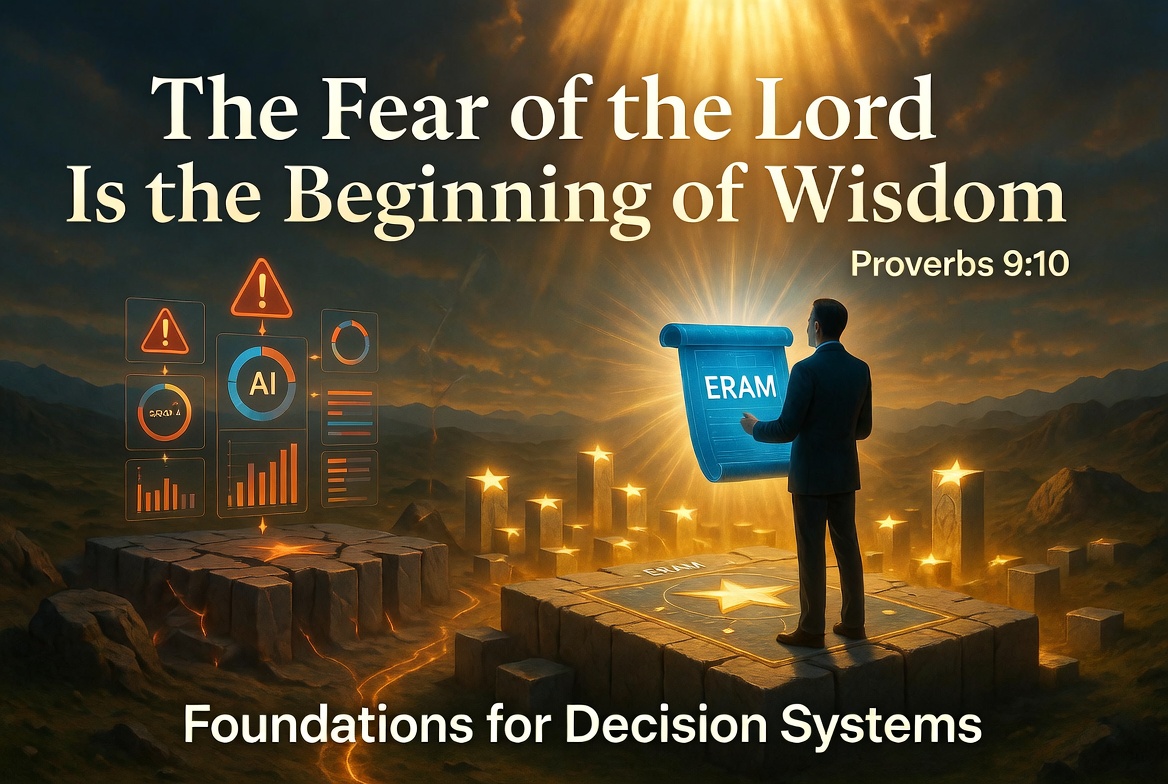
The fear of the Lord is the beginning of wisdom
The Fear of the Lord Is the Beginning of Wisdom – Foundations for Decision Systems
“The fear of the Lord is the beginning of wisdom, and knowledge of the Holy One is understanding.” — Proverbs 9:10
Introduction: The Foundation Beneath Every Foundation
Every system is built upon something.
A building rests upon a foundation.
A business rests upon assumptions.
A reporting system rests upon definitions.
A decision rests upon beliefs.
The quality of the foundation determines the quality of everything built upon it.
This principle is recognized throughout business. Organizations invest heavily in governance, architecture, controls, standards, and processes because they understand that weak foundations create fragile outcomes.
Yet there is a deeper question that leaders rarely ask.
What is the foundation beneath the foundation?
What governs the judgments behind the KPIs?
What shapes the assumptions behind the dashboards?
What influences the priorities behind the decisions?
The Bible provides a surprisingly direct answer.
"The fear of the Lord is the beginning of wisdom."
This verse does not suggest wisdom begins with intelligence, information, education, or technology.
It begins with proper alignment.
And alignment is just as important in decision systems as it is in spiritual life.
The Modern Search for Better Decisions
Organizations constantly pursue better decision-making.
They invest in:
- business intelligence
- reporting platforms
- AI tools
- predictive analytics
- executive dashboards
The goal is simple.
Make better decisions.
Yet despite massive technological advances, organizations continue struggling with:
- poor priorities
- conflicting KPIs
- short-term thinking
- misaligned incentives
- reporting mistrust
Technology solves information problems.
It does not automatically solve wisdom problems.
A company may possess perfect information and still pursue the wrong objective.
This distinction is critical.
Wisdom is not simply about knowing more.
Wisdom is about seeing correctly.
The Difference Between Intelligence and Wisdom
Modern organizations often celebrate intelligence.
Intelligence solves problems.
Intelligence identifies patterns.
Intelligence creates efficiency.
These are valuable capabilities.
But wisdom operates differently.
Wisdom determines:
- which problems deserve attention
- which opportunities should be pursued
- which tradeoffs are acceptable
- which priorities matter most
An intelligent organization can optimize the wrong objective.
A wise organization ensures the objective is correct before optimization begins.
The danger of intelligence without wisdom is that organizations become highly efficient at moving in the wrong direction.
The Fear of the Lord and Organizational Humility
The phrase "fear of the Lord" is often misunderstood.
It is not primarily about terror.
It is about reverence.
It is the recognition that human understanding has limits.
This principle creates humility.
Humility may be one of the most underrated assets in decision-making.
Organizations frequently assume:
- the model is correct
- the forecast is accurate
- the KPI tells the whole story
- the dashboard captures reality
Humility challenges those assumptions.
Humility asks:
What might we be missing?
What assumptions remain untested?
What risks have we overlooked?
This mindset dramatically improves decision quality.
The Foundation of Trustworthy Reporting
Trustworthy reporting begins with intellectual humility.
Without humility, organizations stop questioning.
Without questioning, blind spots multiply.
Without awareness of blind spots, confidence becomes dangerous.
Many reporting failures begin with excessive certainty.
A metric is accepted without validation.
A forecast is trusted without scrutiny.
A recommendation is implemented without understanding.
Humility protects organizations from these mistakes.
It encourages validation, governance, and disciplined decision-making.
Why AI Makes This Principle More Important
Artificial intelligence introduces unprecedented analytical power.
Yet it also creates unprecedented opportunities for overconfidence.
AI systems generate:
- forecasts
- recommendations
- summaries
- predictions
- optimizations
The outputs often appear authoritative.
This creates a subtle risk.
Organizations begin trusting outputs because they appear intelligent.
Wisdom requires a different response.
Wisdom asks:
Should this recommendation be trusted?
What assumptions produced this result?
How was the conclusion generated?
What context may be missing?
The fear of the Lord begins with humility.
Humility improves discernment.
Discernment improves decisions.
The Relationship Between Wisdom and ERAM
The Eden Reporting Architecture Method is often viewed as a technical framework.
Yet beneath every technical decision lies a wisdom decision.
Every ERAM step reflects principles of stewardship, humility, and disciplined thinking.
Step 1: Define Business Objective
Wisdom begins by asking:
What are we truly trying to accomplish?
Many organizations rush into reporting before defining purpose.
Wise organizations begin with clarity.
Step 2: Define Grain
Humility recognizes that assumptions matter.
Defining grain requires careful thinking about what the data actually represents.
Step 3: Transform Data
Transformation involves interpretation.
Wisdom ensures business logic reflects reality rather than convenience.
Step 4: Enforce Star Schema
Order is a recurring biblical principle.
Star schema imposes structure before complexity grows.
Step 5: Build Layered DAX
Transparency improves stewardship.
Layered calculations create explainability and accountability.
Step 6: Stress Test Model
Humility welcomes testing.
Wise organizations actively search for weaknesses before deployment.
Step 7: Validate With Source
Validation reflects humility.
It acknowledges that assumptions require verification.
Step 8: Design Dashboard
Visibility should be built upon trustworthy foundations.
Otherwise appearance replaces reality.
Manufacturing Example: Optimizing the Wrong Objective
Consider a manufacturing organization focused on maximizing throughput.
Dashboards show productivity gains.
Management celebrates.
Months later quality defects rise significantly.
Customer complaints increase.
Warranty costs grow.
The organization optimized one objective while neglecting others.
The reporting worked.
The wisdom did not.
The problem was not lack of information.
The problem was misaligned priorities.
Wisdom ensures organizations pursue the right objectives before optimizing them.
CRM Example: The Illusion of Growth
A CRM team focuses heavily on lead generation.
Dashboards demonstrate increasing lead volume.
Marketing performance appears strong.
Sales conversion rates decline.
Customer acquisition costs rise.
Revenue growth stagnates.
The organization optimized activity rather than outcomes.
Again, the information was accurate.
The wisdom was incomplete.
Wisdom requires evaluating success through the broader context of business objectives.
Organizational Idolatry and Metrics
One of the more uncomfortable lessons from Scripture is that people often elevate tools into idols.
Organizations can do the same.
Metrics become idols.
Dashboards become idols.
Technology becomes an idol.
AI becomes an idol.
The danger is not the tool itself.
The danger is assigning ultimate authority to the tool.
Metrics are indicators.
They are not truth itself.
Dashboards provide visibility.
They do not replace judgment.
AI provides recommendations.
It does not replace wisdom.
The fear of the Lord protects organizations from this trap by reminding leaders that no human system possesses perfect understanding.
The ERAM Audit as a Wisdom Assessment
Most organizations view audits as technical exercises.
The ERAM Audit is also a wisdom exercise.
It evaluates:
- objective clarity
- KPI alignment
- governance maturity
- reporting trust
- validation practices
- architectural stewardship
Many reporting problems are not technical failures.
They are wisdom failures.
Organizations pursue visibility before clarity.
Automation before governance.
Speed before discipline.
The audit reveals where foundational principles have been neglected.
The Competitive Advantage of Wisdom
Technology is becoming widely accessible.
AI capabilities are spreading rapidly.
Information advantages continue shrinking.
Wisdom advantages remain rare.
Organizations that cultivate humility, stewardship, discernment, and disciplined governance create advantages that competitors struggle to replicate.
Because wisdom influences every decision.
And every decision influences outcomes.
Conclusion
The fear of the Lord is the beginning of wisdom.
This principle applies far beyond theology.
It applies to leadership.
It applies to governance.
It applies to reporting architecture.
It applies to decision systems.
Organizations often seek better information.
The deeper need is better wisdom.
Wisdom begins with humility.
Humility encourages validation.
Validation builds trust.
Trust improves decisions.
And better decisions create better outcomes.
The strongest decision systems are not built merely upon technology.
They are built upon wisdom.
Because every foundation ultimately rests upon a deeper foundation.
And wisdom remains the most important foundation of all.
Previous Article: Discernment before decisions
Next Article: Many plans, one counsel
Related Resources
Seek first – The missing principle behind every great decision system
Discover the Eden Reporting Architecture Method (ERAM) — a practical framework for building trusted decision infrastructure, KPI alignment, and scalable reporting systems.
Evaluate your reporting environment with an ERAM Audit and identify hidden risks related to KPI definitions, reporting trust, governance, and decision-making reliability.
