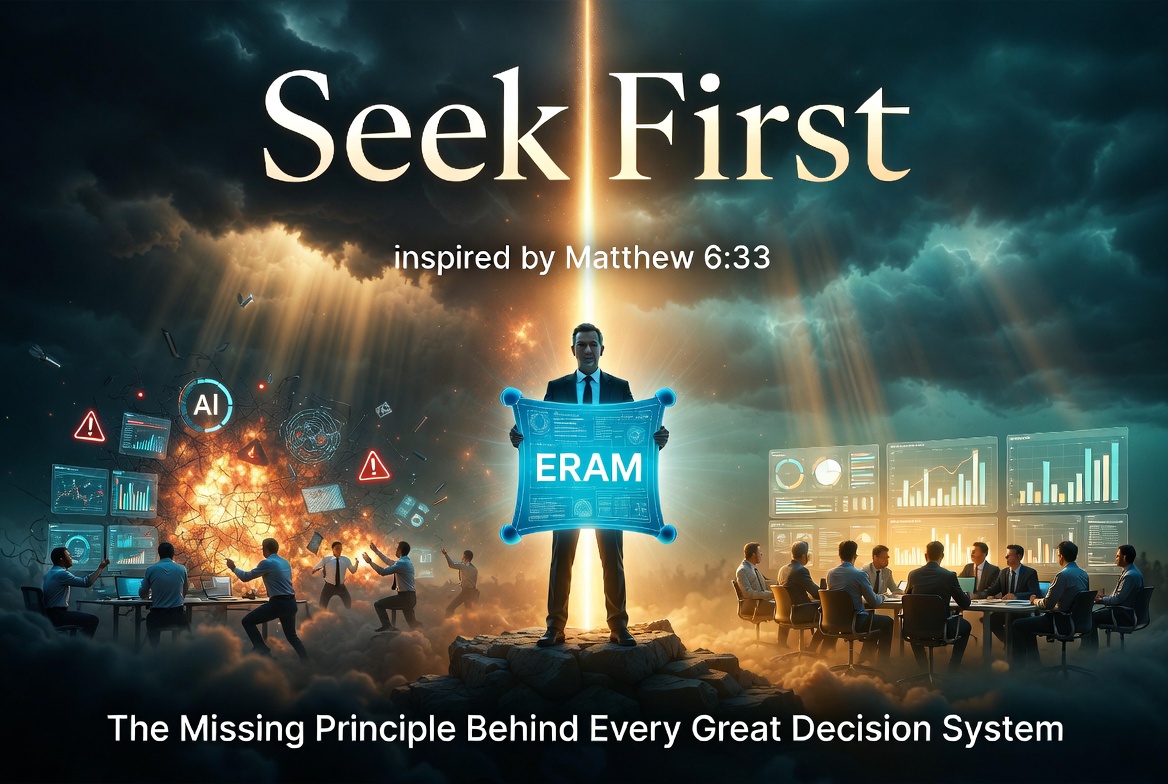
Seek first - The missing principle behind every great decision system
Seek First - The Missing Principle Behind Every Great Decision System
The ERAM Manifesto: Why organizations do not need more visibility first, but better alignment, stewardship, wisdom, and trust.
Introduction: Every Organization Is Seeking Something
Every organization is seeking something.
Some seek growth. Some seek efficiency. Some seek lower costs. Some seek more customers. Some seek more dashboards. Some seek artificial intelligence. Some seek automation. Some seek faster reporting. Some seek better forecasts. Some seek control.
None of these pursuits are necessarily wrong.
Growth can be good. Efficiency can be good. Dashboards can be useful. AI can be powerful. Forecasting can help leaders prepare. Reporting can reveal patterns that would otherwise remain hidden.
The deeper question is not whether these things are valuable.
The deeper question is: what comes first?
That may be one of the most important leadership questions any organization can ask. Because whatever an organization seeks first eventually shapes everything else: its priorities, its culture, its reporting systems, its decision-making habits, and even its understanding of success.
Nearly two thousand years ago, Jesus expressed a principle that is often read devotionally, but rarely considered organizationally:
"But seek first the kingdom of God and His righteousness, and all these things will be added to you." - Matthew 6:33
In context, Jesus was addressing worry about visible and necessary things: food, clothing, provision, survival. He was not denying that these things matter. He was reordering them. He was teaching that when people seek the highest order first, secondary needs find their proper place.
This is not only a spiritual principle. It is also a principle of order.
Organizations suffer when secondary things become primary. They seek visibility before clarity. Speed before discipline. AI before wisdom. Automation before governance. Dashboards before trust. Growth before structure.
And then they wonder why the tools do not deliver what they promised.
The problem is not always the tool. The problem is the order of pursuit.
The Principle of Primary Alignment
Matthew 6:33 is often summarized as a call to put God first. That is true, but the principle goes even deeper.
It teaches primary alignment.
Primary alignment means the highest priority must govern the lower priorities. The first thing must define the meaning of everything that follows. If the first thing is wrong, even useful secondary things become distorted.
This is why organizations can invest heavily in analytics and still make poor decisions. It is why they can deploy sophisticated dashboards and still experience confusion. It is why they can implement AI and still fail to improve decision quality.
They are seeking secondary outcomes without first establishing primary foundations.
A dashboard is secondary. It depends on definitions, structure, trust, and interpretation.
AI is secondary. It depends on data quality, governance, objectives, validation, and judgment.
Reporting is secondary. It depends on the decision it is meant to support.
Metrics are secondary. They depend on the purpose they are meant to measure.
The first thing is not visibility. The first thing is alignment with the right order.
In biblical language, righteousness can be understood not only as moral correctness, but also as alignment with God's order, character, and ways. It includes trustworthiness, justice, stewardship, wisdom, truth, order, faithfulness, and selfless concern for others.
Applied carefully to business, this does not mean turning every dashboard into a sermon. It means recognizing that trustworthy organizations are built on principles that Scripture consistently honors: order, stewardship, truth, wisdom, service, accountability, and alignment.
When these principles come first, reporting systems become healthier.
When they are ignored, reporting systems become mirrors of organizational disorder.
The Reporting Industry's Mistake
Many organizations begin their reporting journey with the visible layer.
They ask:
Can we build a dashboard?
Can we automate the report?
Can we add AI?
Can we give executives more visibility?
Can we refresh the data faster?
These are understandable questions. But they are rarely first questions.
The first questions should be:
What decision are we trying to improve?
Who depends on this information?
Can the numbers be trusted?
Are the definitions aligned?
Is the model structured?
Is the data validated?
Does the system produce clarity or simply visibility?
This is where many organizations lose their way. They pursue reports before they define decisions. They pursue automation before they build governance. They pursue AI before they establish trust.
The result is not progress. It is accelerated confusion.
This is the deeper reason Eden Reporting Architecture Method, ERAM, exists.
ERAM is not simply an eight-step Power BI workflow. It is an attempt to restore first principles to decision systems.
It says that dashboards should not come first.
It says that visibility should not come before structure.
It says that automation should not come before governance.
It says that trust should not be assumed. It must be built.
It says that decision infrastructure must be designed before decision-making can become reliable.
In that sense, ERAM is more than a methodology. It is a philosophy of order applied to reporting systems.
Solomon and the Wisdom of Seeking the Right Thing First
The story of Solomon reinforces the same principle.
When God invited Solomon to ask for what he wanted, Solomon could have asked for riches, long life, victory over enemies, or personal power. Instead, he asked for wisdom to govern the people entrusted to him.
That request pleased God because Solomon did not seek first the visible benefits of leadership. He sought the capacity to steward leadership well.
He did not put himself first. He put responsibility first.
He did not ask first for abundance. He asked first for wisdom.
And because he sought the right thing first, other things were added.
This connects directly with Matthew 6:33. The visible needs matter, but they are not meant to become the highest pursuit. When wisdom, righteousness, and stewardship are first, provision finds its proper place.
Organizations face the same choice.
They can seek faster reports first.
They can seek more automation first.
They can seek AI first.
They can seek growth first.
Or they can seek wisdom first.
Wisdom asks whether the system is trustworthy. Wisdom asks whether definitions are aligned. Wisdom asks whether decision-makers are served well. Wisdom asks whether technology is governed by purpose.
This is why the future of AI in organizations will not be determined only by model quality or platform selection. It will be determined by the wisdom of the organizations using it.
AI in the hands of a wise organization can multiply clarity.
AI in the hands of a disordered organization can multiply confusion.
AI Cannot Change First Principles
Artificial intelligence is one of the most powerful technologies ever introduced into business. It can summarize documents, write code, generate reports, detect patterns, forecast outcomes, and recommend actions.
But AI cannot change first principles.
It can only accelerate the consequences of the principles already present.
If an organization has aligned objectives, AI can accelerate execution.
If an organization has conflicting priorities, AI can accelerate fragmentation.
If KPI definitions are clear, AI can help generate useful interpretation.
If KPI definitions are inconsistent, AI can produce confident confusion.
If governance exists, AI becomes a force multiplier.
If governance is missing, AI becomes a risk multiplier.
This is one of the central challenges of the next decade.
Many organizations will seek AI first because it promises abundance: more productivity, faster analysis, automated decisions, reduced manual effort, and competitive advantage.
But Matthew 6:33 challenges the assumption that seeking the visible benefit first produces the deepest outcome.
Jesus teaches that first things must remain first.
For business leaders, this means AI should not be pursued as a savior. It should be governed as a tool.
Technology does not remove the need for wisdom. It increases it.
Automation does not remove the need for stewardship. It expands it.
Speed does not remove the need for validation. It makes validation more urgent.
AI cannot create a trustworthy decision system out of disordered foundations. It can only reveal, accelerate, and magnify what is already there.
ERAM as a First-Things-First Framework
The eight steps of ERAM follow a deliberate sequence. That sequence matters because it reflects the principle of first things first.
Step 1 - Define Business Objective
ERAM begins with purpose. Not dashboards. Not visuals. Not reports. Purpose.
This is the most direct expression of Matthew 6:33 within reporting architecture. Before any system is built, the organization must ask: what decision are we trying to improve? What business outcome must this reporting system support? Who depends on this information?
When purpose is unclear, every metric competes for attention. When purpose is clear, every metric can be judged in context.
Step 2 - Define Grain
After purpose comes clarity. Grain defines what one row of data represents. A transaction? A customer? A production event? A sales opportunity?
This may sound technical, but it is foundational. Without grain clarity, aggregation becomes unstable, filters behave unpredictably, and conclusions become unreliable.
Seek clarity before aggregation.
Step 3 - Transform Data
Transformation is where raw information is shaped into decision-ready structure. It requires truthfulness. It requires discipline. It requires understanding the business reality behind the data.
Organizations that rush transformation often automate assumptions they have never examined.
Seek truth before convenience.
Step 4 - Enforce Star Schema
Star schema is order made visible. Facts and dimensions are separated. Relationships become predictable. Models become scalable.
This step reflects the Genesis pattern: order before multiplication, separation before function.
Seek order before visibility.
Step 5 - Build Layered DAX
Calculations represent business logic. If logic is scattered, duplicated, or hidden, the organization loses understanding. Layered DAX creates transparency, maintainability, and trust.
Seek understanding before complexity.
Step 6 - Stress Test Model
A system that only works in ideal conditions is not yet reliable. Stress testing reveals whether the model behaves under pressure: different filters, larger volumes, new scenarios, changing questions.
Seek confidence before deployment.
Step 7 - Validate With Source
Trust is not built by design. Trust is built by validation. Critical KPIs must reconcile with source systems. Important calculations must be explainable. Assumptions must be tested.
Seek trust before decisions.
Step 8 - Design Dashboard
Only after the foundation is complete does ERAM design the dashboard. This is the reversal of how many organizations work. They begin with visibility. ERAM ends with visibility.
Seek communication after the foundation is established.
This sequence is not arbitrary. It is the reporting expression of first things first.
Case Study Pattern 1: A Fortune 500 Multinational and KPI Alignment
In one large Fortune 500 multinational environment, the challenge appeared at first to be a reporting challenge. Headquarters needed better consistency with local affiliates. Dashboards and reports were important, but they were not the real breakthrough.
The deeper issue was KPI alignment.
Different groups used the same metric names while applying different interpretations, exclusions, timing assumptions, and business rules. The organization had visibility, but not shared meaning.
This is one of the most important lessons in decision infrastructure:
Visibility cannot compensate for misalignment.
The breakthrough came when the work shifted from producing outputs to clarifying definitions. Once business rules were aligned, reporting became more valuable because the organization could finally interpret the numbers together.
This is Matthew 6:33 in organizational form.
Do not seek the visible output first.
Seek the governing order first.
When alignment came first, visibility became useful.
Case Study Pattern 2: Engineering Reporting and the Cost of Skipping Foundations
In another complex engineering reporting environment, the visible symptoms were technical: long and complex DAX measures, performance problems, inconsistent filter behavior, maintenance pain, and fragile reporting logic.
It would have been easy to treat the problem as a dashboard optimization issue.
But the deeper issue was architectural.
The data model lacked sufficient structure. Fact and dimension logic was unclear. Relationships were difficult to maintain. Many-to-many patterns created unexpected behavior. Change requests became risky because the system was not built on stable foundations.
The lesson was clear:
Optimization cannot replace architecture.
Better DAX alone could not solve the problem. Better visuals could not solve the problem. The system needed first principles restored: objective, grain, structure, logic, testing, validation, then dashboard design.
This is why ERAM insists on sequence.
Organizations often seek performance improvement first. But the first need may be structure.
When structure is restored, performance improvement has something solid to stand on.
Case Study Pattern 3: Continuous Data Quality and Stewardship
In a data quality reporting environment, the challenge was not simply to perform one-time checks. The need was continuous quality monitoring after data refreshes, with alerts to detect issues when they occurred.
That kind of solution reveals another first principle:
Trust is not a one-time event. Trust is a stewardship responsibility.
Many organizations validate once and assume the system will remain trustworthy. But data changes. Systems change. Sources change. Business processes evolve.
Stewardship means maintaining integrity over time.
This connects deeply to Matthew 6:33 because the pursuit is not merely a visible dashboard that says everything is fine. The pursuit is trustworthiness as an ongoing principle.
A system that continuously checks data quality is not only a technical asset. It is a governance expression.
It says: the people depending on this information deserve a system worthy of trust.
Manufacturing Example: Seeking Output Before Foundations
Manufacturing leaders often seek better visibility into production performance. They want OEE, downtime, yield, throughput, scrap, quality, and supplier metrics.
These are important measures.
But if they are sought first, the organization may still struggle.
One plant defines downtime one way. Another plant defines it differently. One team excludes planned maintenance. Another includes it. Yield is calculated differently across lines. Supplier quality metrics vary by region.
The dashboards multiply, but trust declines.
A wiser approach begins with first things:
What operational decision must improve?
How are the metrics defined?
What is the grain of production data?
How are sources validated?
Who owns each KPI?
How will the system behave as plants, products, and processes change?
Only then should dashboards and AI recommendations be scaled.
AI in manufacturing can be extremely powerful: predictive maintenance, anomaly detection, quality forecasting, scheduling optimization. But if it is trained or applied on poorly governed definitions, it may optimize noise.
Manufacturing does not need AI first.
It needs trustworthy decision infrastructure first.
CRM Example: Seeking Pipeline Before Customer Stewardship
CRM environments often reveal the same disorder in a different language.
Organizations seek more leads, more pipeline, more conversion, more attribution, more dashboards, and more forecasting.
But what comes first?
If customer definitions vary across systems, pipeline stages are inconsistent, attribution rules are unclear, and revenue logic differs between sales, marketing, and finance, then CRM analytics becomes a source of conflict.
AI may forecast revenue, score leads, suggest next actions, or summarize customer behavior. But AI cannot create stewardship where stewardship is absent.
A customer is not merely a record in a CRM. A customer relationship is a stewardship responsibility.
This means reporting should serve the relationship, not merely the internal metric.
Matthew 6:33 challenges organizations to seek the right order first. In CRM, that order may look like:
Customer stewardship before pipeline volume.
Definition before attribution.
Trust before forecast automation.
Alignment before executive dashboards.
When those priorities are honored, CRM analytics becomes a tool for better decisions. When they are ignored, CRM reporting becomes another arena of disagreement.
Secondary Things Cannot Produce Primary Outcomes
One of the deepest lessons of Matthew 6:33 is that secondary things cannot produce primary outcomes.
Food and clothing matter, but they cannot produce the Kingdom.
In organizations, dashboards matter, but they cannot produce trust by themselves.
AI matters, but it cannot produce wisdom by itself.
Automation matters, but it cannot produce alignment by itself.
KPIs matter, but they cannot produce purpose by themselves.
Reports matter, but they cannot produce decision quality by themselves.
Primary outcomes require primary foundations.
Trust requires validation.
Clarity requires structure.
Alignment requires shared definitions.
Wisdom requires discernment.
Stewardship requires responsibility.
Decision quality requires architecture.
This is the central reason many technology investments disappoint. Organizations expect secondary tools to produce primary outcomes.
ERAM reverses that expectation.
It begins with the foundations that make tools valuable.
The Hierarchy of a Trustworthy Decision System
If we had to express this article as a hierarchy, it might look like this:
Purpose
Principles
People
Process
Technology
AI
Dashboards
Reports
Most organizations reverse the order.
They start with reports. Then dashboards. Then tools. Then AI. Then process. Then people. Then principles. And sometimes, only after failure, they rediscover purpose.
But sustainable systems are built the other way.
Purpose defines what matters.
Principles define what must not be compromised.
People steward the system.
Processes make stewardship repeatable.
Technology enables execution.
AI accelerates capability.
Dashboards communicate insight.
Reports provide visibility.
When the hierarchy is inverted, organizations become visible but not wise.
When the hierarchy is restored, decision systems become trustworthy.
The ERAM Manifesto
Organizations do not need more dashboards first.
They need better foundations.
They do not need faster AI first.
They need wiser priorities.
They do not need more visibility first.
They need greater alignment.
They do not need more reporting first.
They need decision systems worthy of the people who depend on them.
This is why Eden Data Studio exists.
Not simply to build reports.
Not simply to redesign dashboards.
Not simply to optimize Power BI models.
Those things matter, but they are secondary.
The deeper purpose is to help organizations move from information to understanding, from understanding to wisdom, from wisdom to trustworthy decisions, and from trustworthy decisions to faithful stewardship.
ERAM is one practical expression of that purpose.
It brings first principles back into reporting architecture.
It restores order before visibility.
It restores definitions before calculations.
It restores validation before trust.
It restores purpose before dashboards.
Conclusion: Seek First
Every organization is seeking something.
The question is whether it is seeking the right thing first.
Matthew 6:33 is not a rejection of provision, growth, work, or visible outcomes. It is a reordering of them.
Seek first the Kingdom.
Seek first the higher order.
Seek first righteousness, alignment with that order.
Then the secondary things find their place.
For modern organizations, this principle is deeply practical.
Seek purpose before metrics.
Seek stewardship before automation.
Seek alignment before visibility.
Seek trust before decisions.
Seek wisdom before AI.
Seek structure before scale.
Seek decision infrastructure before dashboards.
Because everything in an organization eventually reflects whatever it seeks first.
If an organization seeks speed first, it may scale confusion.
If it seeks visibility first, it may expose disorder.
If it seeks AI first, it may automate misalignment.
But if it seeks wisdom, stewardship, order, trust, and alignment first, then technology becomes useful. Dashboards become reliable. AI becomes governed. Reporting becomes meaningful. Decisions become clearer.
And growth becomes more sustainable.
Reliable decisions are the natural fruit of aligned foundations.
That is the heart of ERAM.
That is the deeper vision of Eden Data Studio.
And that is why the first question is not: what can we build?
The first question is: what are we seeking first?
Previous Article: Testing every spirit: AI Recommandations
Next Article:
Related Resources
Dashboards are not infrastructure
Discernment before decisions
The fear of the Lord is the beginning of wisdom
Discover the Eden Reporting Architecture Method (ERAM) — a practical framework for building trusted decision infrastructure, KPI alignment, and scalable reporting systems.
Evaluate your reporting environment with an ERAM Audit and identify hidden risks related to KPI definitions, reporting trust, governance, and decision-making reliability.
