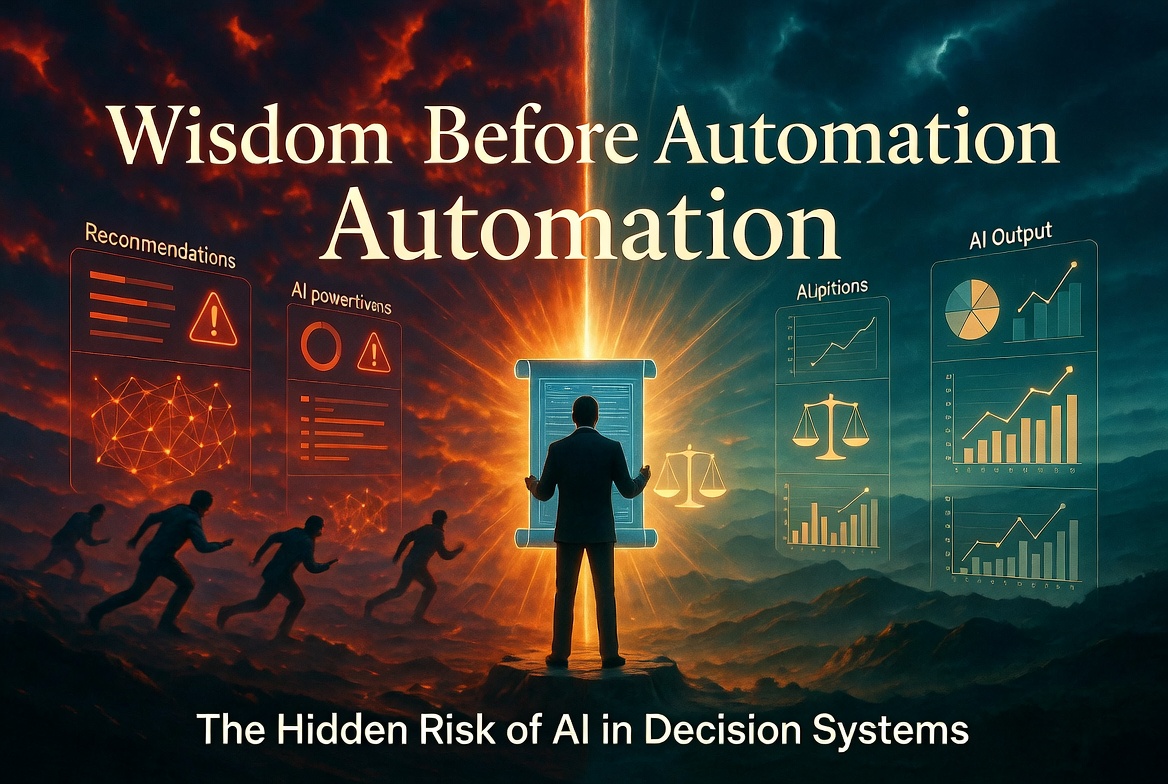
Wisdom before automation
Wisdom Before Automation – The Hidden Risk of AI in Decision Systems
“Desire without knowledge is not good—how much more will hasty feet miss the way!” — Proverbs 19:2
Introduction: The New Gold Rush
Artificial Intelligence has become the modern gold rush.
Organizations everywhere are rushing to implement AI-powered dashboards, automated reporting, predictive analytics, intelligent forecasting, and automated decision support systems. Vendors promise unprecedented productivity. Consultants promise transformation. Executives fear being left behind.
In many ways, the excitement is justified.
AI is a remarkable technology.
Yet hidden beneath the enthusiasm lies a dangerous assumption:
If automation is good, more automation must be better.
Biblical wisdom challenges that assumption.
Scripture consistently teaches that wisdom must govern power. Stewardship must govern resources. Character must govern authority.
The same principle applies to artificial intelligence.
The greatest risk facing modern organizations is not that AI will fail.
It is that AI will succeed in automating systems that were never trustworthy in the first place.
Automation without wisdom simply scales confusion.
The Difference Between Knowledge and Wisdom
One of the recurring themes throughout Proverbs is the distinction between knowledge and wisdom.
Knowledge gathers facts.
Wisdom understands how to apply them.
AI possesses extraordinary capabilities for processing information. It can analyze patterns, summarize reports, generate calculations, identify anomalies, and recommend actions.
But AI does not possess wisdom.
It does not understand organizational trust.
It does not understand stewardship.
It does not understand accountability.
It does not understand consequences.
This distinction matters because many organizations are beginning to confuse intelligence with wisdom.
A machine may generate an answer.
Wisdom determines whether the answer should be trusted.
The Hidden Risk of Automation
Most organizations focus on what AI can automate.
Few ask what should never be automated without proper governance.
Automation multiplies whatever already exists.
If the underlying architecture is strong, automation creates tremendous value.
If the architecture is weak, automation creates larger and faster failures.
This principle mirrors many biblical warnings about power.
Power itself is not dangerous.
Power without wisdom is dangerous.
AI is power.
Wisdom must govern it.
Why ERAM Matters More in the AI Era
Many organizations believe AI reduces the need for reporting architecture.
The opposite is true.
The more automation an organization introduces, the more important architecture becomes.
ERAM provides the discipline layer that prevents AI from amplifying hidden weaknesses.
Without architecture, automation becomes acceleration without direction.
With architecture, automation becomes a force multiplier.
AI Risk Across the Eight ERAM Steps
Step 1: Define Business Objective
The first risk of AI is distraction.
AI can generate hundreds of insights, recommendations, and opportunities.
Without a clearly defined objective, organizations begin chasing interesting outputs instead of strategic outcomes.
Manufacturing Example:
An AI system identifies dozens of production anomalies.
Which one matters most?
Without a clearly defined operational objective, teams become reactive rather than strategic.
CRM Example:
An AI model identifies hundreds of sales patterns.
Without clarity on business priorities, leadership becomes overwhelmed by possibilities instead of focused on outcomes.
Wisdom begins by defining purpose.
Step 2: Define Grain
Grain is one of the least understood concepts in analytics.
AI can generate impressive calculations while completely misunderstanding the level of detail represented by the data.
Customer-level data may be combined with transaction-level data.
Daily metrics may be mixed with monthly summaries.
The outputs appear sophisticated.
The conclusions become unreliable.
Wisdom requires understanding before automation.
Step 3: Transform Data
Organizations increasingly use AI-assisted transformation logic.
This creates enormous productivity gains.
However, transformation errors become more dangerous when automated.
One poorly understood business rule can be replicated across hundreds of reports.
The scale of the error grows exponentially.
Wise organizations validate transformations before scaling them.
Step 4: Enforce Star Schema
AI often prioritizes immediate functionality.
Architecture prioritizes sustainability.
Many AI-generated models work technically while violating fundamental architectural principles.
Initially, they appear successful.
Later they become difficult to maintain, scale, and trust.
The temptation of shortcuts is not new.
AI simply makes shortcuts easier.
Wisdom chooses long-term reliability over short-term convenience.
Step 5: Build Layered DAX
Perhaps nowhere is AI's temptation more visible than in measure generation.
A user can now request dozens of DAX calculations within minutes.
The result often appears productive.
Yet organizations rapidly accumulate:
- duplicated calculations
- inconsistent business logic
- conflicting definitions
- technical debt
Layered DAX provides discipline.
Instead of allowing calculations to multiply uncontrollably, logic is organized into manageable and reusable components.
Wisdom creates order before growth.
Step 6: Stress Test Model
AI frequently creates confidence.
Confidence is not the same thing as trust.
Trust requires testing.
Many organizations assume that because a model works today it will continue working tomorrow.
Stress testing reveals weaknesses hidden beneath successful demonstrations.
How does the model behave under scale?
What happens when filters change?
What happens when business rules evolve?
The prudent give thought to their steps.
That principle applies directly to analytics.
Step 7: Validate With Source
This may be the most important AI governance principle of all.
AI-generated outputs often sound convincing.
That does not make them correct.
One of the greatest dangers of modern AI is the illusion of authority.
Recommendations appear intelligent.
Forecasts appear precise.
Summaries appear trustworthy.
Yet none of these replace validation.
Every critical KPI must reconcile with source systems.
Every important recommendation should be explainable.
Validation protects organizational trust.
Step 8: Design Dashboard
AI can generate beautiful dashboards almost instantly.
This capability creates another illusion.
Organizations begin believing dashboard quality equals decision quality.
The two are not the same.
A visually stunning dashboard built on weak foundations simply accelerates confusion.
Visibility is not clarity.
Architecture must come before presentation.
Manufacturing Example: Automation Without Wisdom
Consider two manufacturing companies implementing predictive maintenance.
The first company deploys AI immediately.
Sensor data lacks standardization.
Failure definitions vary by plant.
Downtime metrics are inconsistent.
The AI model produces recommendations.
Trust declines because nobody understands why recommendations differ across facilities.
The second company establishes:
- common definitions
- standardized metrics
- governance processes
- validation procedures
Only then is AI introduced.
The technology is identical.
The outcomes are dramatically different.
One organization automated confusion.
The other automated wisdom.
CRM Example: Automation Without Governance
Now consider CRM analytics.
A company deploys AI forecasting across its sales organization.
Every region defines opportunities differently.
Customer definitions vary.
Pipeline stages are inconsistent.
Revenue attribution lacks governance.
The forecasting engine becomes highly sophisticated.
The forecasts remain unreliable.
A second company begins with governance.
Customer definitions are standardized.
Pipeline stages are aligned.
Metrics are validated.
Only then is forecasting introduced.
The difference is not AI.
The difference is wisdom.
The ERAM Audit in the Age of AI
Many executives assume their biggest challenge is choosing the right AI platform.
Often their biggest challenge is determining whether their existing reporting architecture can support AI at all.
This is one reason the ERAM Audit becomes increasingly valuable.
The audit evaluates:
- objective clarity
- KPI alignment
- grain consistency
- transformation quality
- model architecture
- validation practices
- reporting trust
The goal is not simply identifying technical weaknesses.
The goal is identifying areas where automation would amplify risk.
An organization should understand its foundations before accelerating them.
Wisdom Before Automation
Throughout Scripture, wisdom consistently precedes power.
Preparation precedes multiplication.
Stewardship precedes growth.
The same principle applies to artificial intelligence.
Organizations that pursue automation before wisdom often create larger versions of existing problems.
Organizations that pursue wisdom before automation create sustainable competitive advantages.
The future will belong to organizations that combine AI with governance, automation with stewardship, and innovation with wisdom.
Conclusion
Artificial intelligence is transforming business.
The question is not whether organizations should adopt it.
The question is whether they will adopt it wisely.
Automation is powerful.
But power without wisdom has always been dangerous.
The most successful organizations of the next decade will not necessarily be those that automate the most.
They will be those that automate the wisest.
Because wisdom creates trust.
Trust creates decisions.
And decisions create results.
Before pursuing more automation, organizations should ask a more important question:
Have we built the wisdom required to govern it?
Previous Article: Discipline before speed in reporting
Next Article: Why validation creates trust
Related Resources
Discover the Eden Reporting Architecture Method (ERAM) — a practical framework for building trusted decision infrastructure, KPI alignment, and scalable reporting systems.
Evaluate your reporting environment with an ERAM Audit and identify hidden risks related to KPI definitions, reporting trust, governance, and decision-making reliability.
