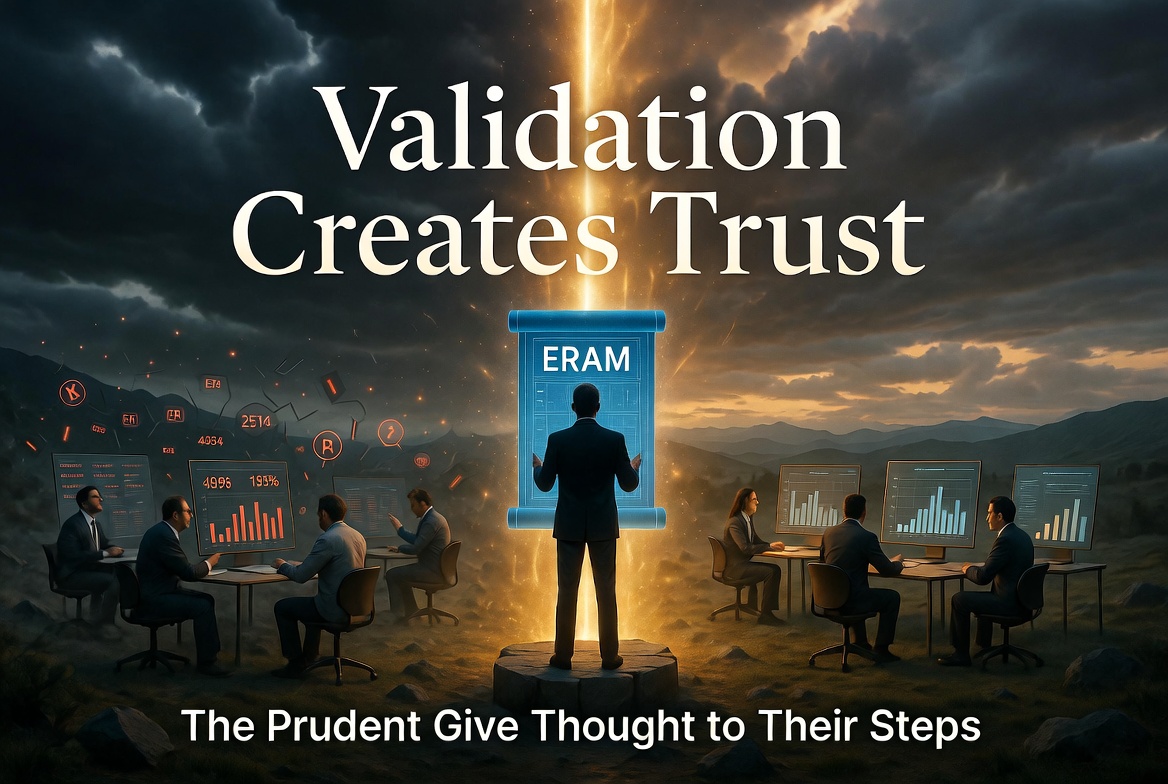
Why validation creates trust
The Prudent Give Thought to Their Steps – Why Validation Creates Trust
“The simple believe anything, but the prudent give thought to their steps.” — Proverbs 14:15
Introduction: The Invisible Foundation of Every Decision
Trust is one of the most valuable assets any organization possesses.
Without trust, decisions slow down.
Without trust, teams argue.
Without trust, leaders hesitate.
Without trust, reporting becomes noise.
Yet trust is often misunderstood.
Many organizations believe trust is created through better dashboards, more sophisticated analytics, or newer technology.
In reality, trust is built through validation.
The most trusted organizations are rarely those with the most reports.
They are the organizations that consistently prove their numbers can be trusted.
This principle has become even more important in the age of artificial intelligence.
Modern leaders are surrounded by data, reports, forecasts, alerts, recommendations, and AI-generated insights. The challenge is no longer obtaining information.
The challenge is determining what deserves trust.
Biblical wisdom provides a surprisingly relevant answer.
The prudent do not simply accept information.
They verify it.
The Hidden Cost of Assumption
One of the greatest threats to decision quality is assumption.
Organizations assume:
- KPIs are calculated correctly
- source systems are accurate
- dashboards are aligned
- AI recommendations are valid
- definitions are shared
These assumptions often remain hidden until trust breaks.
A sales report differs from finance.
Operations disputes manufacturing metrics.
Executive dashboards conflict with departmental reports.
The problem is rarely the dashboard itself.
The problem is the absence of validation.
Trust cannot be assumed.
Trust must be earned.
Biblical Wisdom and Verification
Throughout Scripture, wisdom is repeatedly connected to discernment.
Wise people do not accept claims blindly.
They evaluate.
They test.
They examine.
Proverbs 14:15 teaches that the simple believe anything, while the prudent think carefully about their steps.
This principle applies directly to reporting architecture.
Every KPI is a claim.
Every dashboard is a claim.
Every AI recommendation is a claim.
The wise organization validates those claims before acting on them.
Validation Is the Foundation of Trust
Trust does not begin at the dashboard.
Trust begins long before a dashboard exists.
Trust begins when organizations establish repeatable validation practices.
Consider how trust develops in other domains.
Manufacturing relies on quality control.
Accounting relies on audits.
Engineering relies on testing.
Medicine relies on verification.
Business intelligence is no different.
Reliable reporting requires disciplined validation.
Why Modern Technology Makes Validation More Important
Many leaders assume modern technology reduces the need for validation.
The opposite is true.
As systems become more complex, validation becomes more important.
Artificial intelligence is a perfect example.
AI can generate:
- forecasts
- summaries
- recommendations
- KPIs
- dashboards
almost instantly.
The speed is remarkable.
The risk is equally remarkable.
A wrong answer delivered quickly remains wrong.
The illusion of authority is one of AI's greatest dangers.
Outputs often appear confident.
Confidence is not evidence.
Validation transforms confidence into trust.
ERAM Step 7: Validate With Source
Among the eight ERAM (Eden Reporting Architecture Method) steps, Step 7 may be the most directly connected to trust.
Many reporting initiatives focus heavily on visualization.
Few invest equal effort in validation.
Yet validation determines whether executives trust the final product.
The objective of Step 7 is simple:
Ensure every critical KPI can be reconciled with its source.
If a number cannot be explained, it cannot be trusted.
If it cannot be trusted, it cannot reliably support decisions.
Validation Across the ERAM Framework
Although Step 7 focuses specifically on validation, every ERAM step contributes to trust.
Step 1: Define Business Objective
Validation begins by confirming that reporting supports the correct business objective.
If objectives are unclear, success cannot be validated.
Step 2: Define Grain
Many reporting inconsistencies originate from grain confusion.
Validation confirms data exists at the intended level of detail.
Step 3: Transform Data
Transformation logic must be verified.
Every business rule introduces potential risk.
Validation confirms that transformed data reflects reality.
Step 4: Enforce Star Schema
A disciplined model structure makes validation easier.
Poor architecture hides errors.
Good architecture exposes them.
Step 5: Build Layered DAX
Layered calculations improve transparency.
Validation becomes easier because business logic is visible and traceable.
Step 6: Stress Test Model
Stress testing validates behavior under changing conditions.
Weaknesses are discovered before users encounter them.
Step 7: Validate With Source
Direct reconciliation builds confidence.
This is where trust becomes measurable.
Step 8: Design Dashboard
Only after validation is complete should information be visualized.
Visibility without validation creates false confidence.
Manufacturing Example: Quality Control for Data
Manufacturing leaders understand the importance of validation instinctively.
Imagine a factory producing aerospace components.
Would quality inspections be optional?
Of course not.
The cost of failure is too high.
The same principle applies to reporting.
Suppose a manufacturing organization tracks:
- OEE
- downtime
- scrap rate
- yield
- on-time delivery
If these metrics are not validated, operational decisions become unreliable.
Production schedules may be adjusted incorrectly.
Maintenance priorities may be misallocated.
Investment decisions may be distorted.
Validation functions as quality control for decision systems.
CRM Example: The Cost of Unvalidated Metrics
CRM analytics presents similar challenges.
A sales organization may track:
- pipeline value
- forecast accuracy
- conversion rates
- customer acquisition cost
- revenue attribution
Without validation, these metrics become vulnerable to:
- inconsistent definitions
- duplicate records
- attribution errors
- incorrect calculations
AI forecasting cannot compensate for unreliable inputs.
Validation remains essential.
Why Trust Compounds
One of the most interesting characteristics of trust is that it compounds over time.
Every validated KPI increases confidence.
Every accurate forecast strengthens credibility.
Every reconciled dashboard improves adoption.
Eventually users stop questioning the system.
Not because they are naïve.
Because the system has repeatedly demonstrated reliability.
Trust becomes an organizational asset.
The opposite is also true.
One major reporting failure can damage trust for years.
This is why validation deserves far more attention than visualization.
The ERAM Audit and Trust Assessment
Many organizations believe their reporting challenge is technical.
Often it is actually a trust problem.
The ERAM Audit helps identify trust risks before they become business problems.
The audit examines:
- KPI definitions
- validation processes
- reconciliation practices
- architectural weaknesses
- governance gaps
The objective is not merely finding errors.
The objective is understanding whether leaders can trust their decision infrastructure.
Trustworthy reporting is not an accident.
It is the result of disciplined architecture and validation.
The Age of AI Requires More Prudence, Not Less
Artificial intelligence is transforming business.
This transformation creates extraordinary opportunities.
It also increases the importance of discernment.
Organizations will soon receive more recommendations than ever before.
More forecasts.
More alerts.
More insights.
More automated decisions.
The question is not whether information will increase.
The question is whether wisdom will increase with it.
The prudent give thought to their steps.
That principle may become one of the most important competitive advantages of the next decade.
Organizations that validate will trust.
Organizations that trust will decide faster.
Organizations that decide faster will outperform.
Conclusion
Trust is not created by dashboards.
Trust is not created by AI.
Trust is not created by visualization.
Trust is created through validation.
Biblical wisdom teaches that prudent people examine carefully before acting.
The same principle applies to decision infrastructure.
Every KPI should be explainable.
Every report should be reconcilable.
Every recommendation should be validated.
Because trustworthy decisions require trustworthy information.
And trustworthy information requires disciplined validation.
The prudent give thought to their steps.
Wise organizations do the same.
That is how trust is built.
And trust remains one of the most valuable assets any reporting system can possess.
Previous Article: Wisdom before automation
Next Article: The ant and the analyst
Related Resources
Discover the Eden Reporting Architecture Method (ERAM) — a practical framework for building trusted decision infrastructure, KPI alignment, and scalable reporting systems.
Evaluate your reporting environment with an ERAM Audit and identify hidden risks related to KPI definitions, reporting trust, governance, and decision-making reliability.
