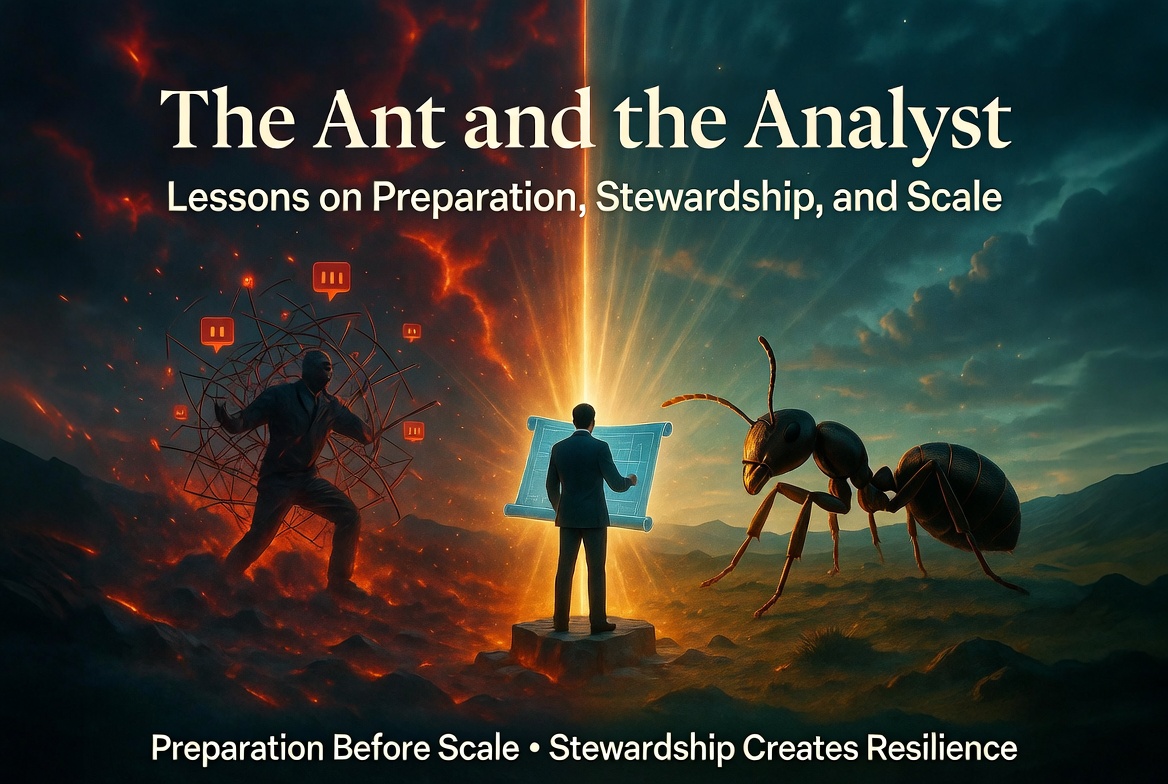
The ant and the analyst
The Ant and the Analyst – Lessons on Preparation, Stewardship, and Scale
“Go to the ant, you sluggard; consider its ways and be wise! It has no commander, no overseer or ruler, yet it stores its provisions in summer and gathers its food at harvest.” — Proverbs 6:6–8
Introduction: Wisdom Hidden in Small Things
One of the most remarkable aspects of biblical wisdom is that it often teaches profound lessons through simple observations.
In Proverbs, Solomon points to one of the smallest creatures in creation: the ant.
The ant possesses no sophisticated technology.
No management hierarchy.
No advanced forecasting software.
No artificial intelligence.
Yet it demonstrates something many organizations struggle to master:
Preparation.
The ant prepares before the need becomes urgent.
It gathers before scarcity arrives.
It organizes before pressure appears.
It thinks beyond the present moment.
This principle has enormous implications for modern reporting architecture, business intelligence, and decision infrastructure.
Many organizations wait until growth exposes weaknesses before investing in governance, architecture, validation, and reporting discipline.
The ant teaches a different lesson.
Prepare before growth arrives.
The Modern Reporting Problem
Most organizations do not ignore reporting intentionally.
The problem is timing.
When business is small:
- spreadsheets appear sufficient
- manual reporting seems manageable
- KPI definitions feel obvious
- governance appears unnecessary
Growth changes everything.
New products emerge.
New customers arrive.
New teams form.
New locations open.
New systems are introduced.
The architecture that worked yesterday suddenly becomes inadequate.
What once felt efficient becomes fragile.
The question is not whether growth will expose weaknesses.
The question is whether preparation occurred beforehand.
The Wisdom of Preparation
Preparation is one of the most overlooked principles in modern business.
Organizations often celebrate execution.
They celebrate speed.
They celebrate innovation.
Yet Scripture consistently emphasizes preparation.
The ant prepares.
Farmers prepare.
Builders prepare.
Stewards prepare.
Preparation is not wasted effort.
Preparation creates resilience.
This principle applies directly to decision systems.
The organizations that scale successfully are rarely the organizations that move fastest.
They are the organizations that prepare most effectively.
Growth Reveals Weak Systems
One of the recurring themes throughout ERAM is that growth does not create weaknesses.
Growth reveals them.
A poorly defined KPI may remain hidden while a company has ten users.
The same KPI becomes a major source of conflict when hundreds of users depend on it.
A weak data model may survive a single dashboard.
The same model may fail under enterprise-scale reporting.
Growth acts like pressure.
Pressure exposes structure.
This is why preparation matters.
The ant prepares before pressure arrives.
Wise organizations do the same.
The Difference Between Activity and Stewardship
Many organizations confuse activity with stewardship.
Activity focuses on immediate outputs.
Stewardship focuses on long-term sustainability.
An analyst can create dashboards quickly.
A steward builds systems that remain reliable years later.
A developer can automate reports rapidly.
A steward ensures automation remains trustworthy as complexity increases.
Stewardship asks a different question:
What will happen when this system grows?
The ant demonstrates stewardship because it thinks beyond today's needs.
Reporting architecture requires the same mindset.
ERAM and the Discipline of Preparation
The Eden Reporting Architecture Method is fundamentally a preparation framework.
Each step prepares the organization for future scale.
Step 1: Define Business Objective
Preparation begins with clarity.
Many organizations create reports before understanding the decisions they are meant to support.
This works temporarily.
Growth magnifies confusion.
A clearly defined objective creates a stable foundation for future expansion.
The ant gathers with purpose.
Wise organizations report with purpose.
Step 2: Define Grain
Grain is preparation for scale.
When organizations neglect grain, reporting appears functional initially.
As data volume grows, inconsistencies emerge.
Users begin asking:
Why don't these numbers match?
Why do different reports produce different answers?
Preparation requires establishing clear levels of detail before growth occurs.
Step 3: Transform Data
Transformation creates consistency.
Organizations that prepare transformation logic carefully create scalable decision systems.
Organizations that neglect transformation create growing complexity.
Manual workarounds multiply.
Errors accumulate.
Preparation prevents future chaos.
Step 4: Enforce Star Schema
Star schema represents architectural stewardship.
It often requires more discipline initially.
However, it dramatically improves scalability.
The ant invests effort today for future stability.
Star schema follows the same principle.
Shortcuts may feel productive now.
Preparation creates reliability later.
Step 5: Build Layered DAX
Many organizations treat calculations as isolated solutions.
Layered DAX treats calculations as reusable assets.
This distinction becomes critical as reporting grows.
Preparation organizes logic before complexity multiplies.
Wisdom creates structure before expansion.
Step 6: Stress Test Model
Preparation anticipates future conditions.
Stress testing asks:
What happens when usage increases?
What happens when requirements change?
What happens when new dimensions are introduced?
The ant prepares for future seasons.
Stress testing prepares for future demands.
Step 7: Validate With Source
Validation protects trust.
As organizations scale, trust becomes increasingly valuable.
Preparation ensures trust is established before executives depend heavily on reporting.
Trust is difficult to earn.
Preparation protects it.
Step 8: Design Dashboard
Only after preparation is complete should visibility become the focus.
Many organizations reverse the order.
The ant teaches patience.
ERAM teaches patience.
Visibility should be built upon preparation.
Manufacturing Example: Preparing for Scale
Consider two manufacturing companies.
Company A experiences rapid growth.
New facilities are added.
Reporting remains largely unchanged.
Each plant defines metrics differently.
Data governance is minimal.
Initially growth appears successful.
Eventually operational conflicts emerge.
Executives spend increasing amounts of time reconciling numbers.
Trust declines.
Company B takes a different approach.
Before expansion:
- KPI definitions are standardized
- governance processes are documented
- reporting architecture is aligned
- validation procedures are established
Growth still introduces challenges.
However, the foundation remains stable.
The difference is preparation.
The ant prepared before winter.
Company B prepared before scale.
CRM Example: Customer Growth and Stewardship
The same principle applies in CRM analytics.
A small sales organization may function effectively without strict governance.
Growth changes the environment.
New regions appear.
New products are launched.
Additional sales teams are introduced.
Without preparation:
- customer definitions diverge
- pipeline stages become inconsistent
- attribution models conflict
- forecasting accuracy declines
Wise organizations prepare before growth creates these problems.
Governance becomes stewardship of future scale.
The AI Acceleration Challenge
Artificial intelligence introduces a new dimension to this discussion.
AI accelerates execution.
The ant teaches preparation.
These are not opposing ideas.
They are complementary.
Organizations that combine preparation with AI create extraordinary advantages.
Organizations that use AI without preparation often scale confusion.
AI can generate:
- dashboards
- calculations
- forecasts
- insights
But it cannot replace preparation.
Preparation remains a human responsibility.
The danger is assuming AI removes the need for stewardship.
In reality, AI increases the importance of stewardship.
The ERAM Audit as a Preparation Assessment
Many organizations seek audits after trust has already been damaged.
The wiser approach is prevention.
The ERAM Audit evaluates whether the organization is prepared for future growth.
It examines:
- objective clarity
- KPI governance
- grain consistency
- transformation quality
- architectural scalability
- validation practices
- reporting reliability
The audit identifies weaknesses while they are still manageable.
This mirrors the wisdom of the ant.
Preparation occurs before crisis.
Preparation occurs before pressure.
Preparation occurs before growth reveals weaknesses.
Preparation Is a Competitive Advantage
One of the most overlooked business truths is that preparation compounds.
Every governance decision compounds.
Every architectural improvement compounds.
Every validated KPI compounds.
Every documented process compounds.
The organizations that invest consistently in preparation create advantages that become increasingly difficult to replicate.
Preparation is not glamorous.
Neither is governance.
Neither is validation.
Yet these disciplines often determine long-term success.
Conclusion
The ant teaches a simple but powerful lesson.
Wise creatures prepare before they must.
The same principle applies to organizations.
Reporting architecture is not merely a technical discipline.
It is an exercise in stewardship.
Organizations that prepare before growth arrives create scalable decision systems.
Organizations that delay preparation often discover that growth exposes weaknesses they can no longer ignore.
The future belongs to organizations that think beyond today's dashboards and prepare for tomorrow's complexity.
The ant understood this principle.
Wise leaders should too.
Because preparation creates trust.
Trust supports scale.
And scale creates opportunity.
That is why the ant remains one of the most powerful teachers of wisdom in all of Scripture.
Previous Article: Why validation creates trust
Next Article: Counting the cost
Related Resources
Discover the Eden Reporting Architecture Method (ERAM) — a practical framework for building trusted decision infrastructure, KPI alignment, and scalable reporting systems.
Evaluate your reporting environment with an ERAM Audit and identify hidden risks related to KPI definitions, reporting trust, governance, and decision-making reliability.
