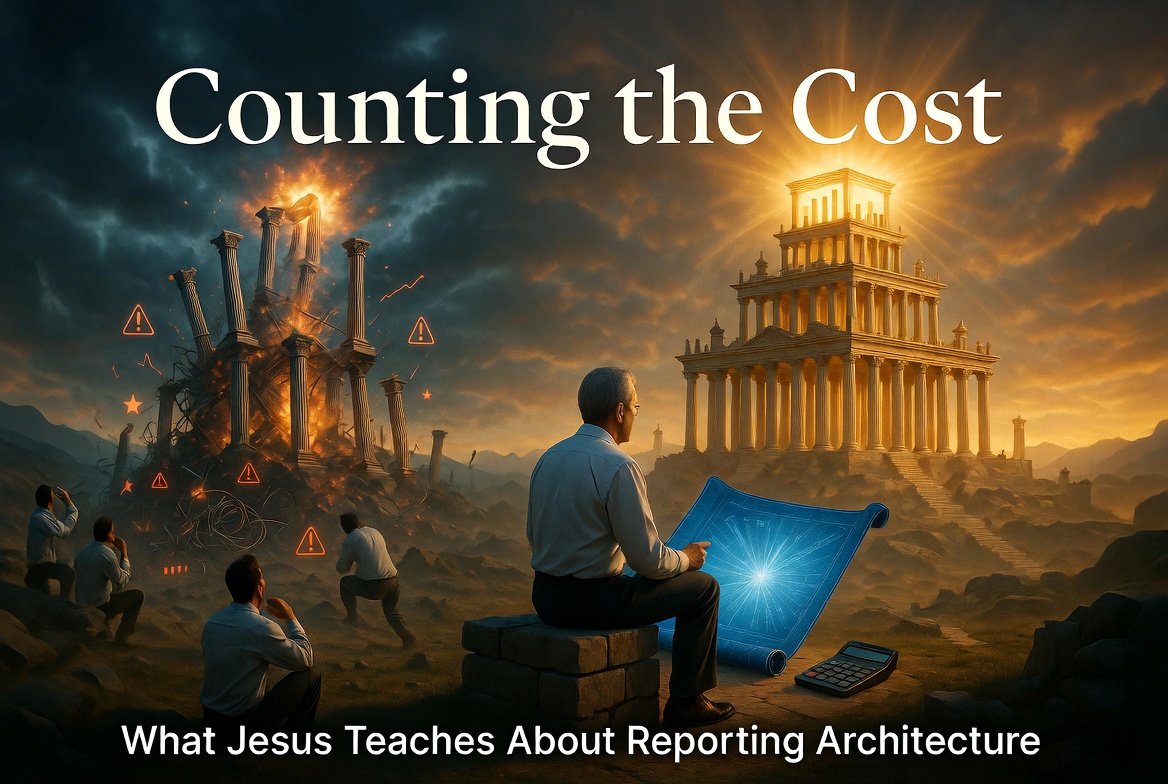
Counting the cost
Counting the Cost – What Jesus Teaches About Reporting Architecture
“Suppose one of you wants to build a tower. Won’t you first sit down and estimate the cost to see if you have enough money to complete it?” — Luke 14:28
Introduction: The Tower Most Organizations Never Finish
Jesus used a simple example to teach a profound principle.
Before building a tower, a wise person counts the cost.
The objective is not merely starting the project.
The objective is finishing it successfully.
Few principles are more relevant to modern reporting systems.
Organizations launch dashboards.
Analytics initiatives begin.
Data platforms are implemented.
AI programs are deployed.
Reporting transformations are announced.
The enthusiasm is often genuine.
The planning is often insufficient.
Many organizations focus on the cost of building.
Few calculate the cost of maintaining, governing, scaling, validating, and trusting the system after it has been built.
As a result, countless reporting initiatives become unfinished towers.
The dashboards exist.
The trust does not.
The Cost Nobody Measures
Most organizations understand visible costs.
They budget for:
- software licenses
- consultants
- developers
- infrastructure
- implementation projects
These costs are easy to identify.
The more dangerous costs are hidden.
Few organizations calculate:
- governance debt
- reporting debt
- KPI debt
- architecture debt
- validation debt
- AI debt
Yet these hidden liabilities often determine success or failure.
The tower does not collapse because construction began.
It collapses because the full cost was never considered.
The Modern Reporting Trap
Technology has made building easier than ever.
Dashboards can be created quickly.
AI can generate reports instantly.
Data can be connected within hours.
The visible portion of reporting has become easier.
The invisible portion remains difficult.
Organizations often assume:
If the dashboard works, the project succeeded.
This assumption is dangerous.
A reporting system is not a dashboard.
It is a decision infrastructure.
The dashboard is simply the visible surface.
The architecture beneath determines whether the system remains reliable as complexity grows.
Jesus warned against beginning construction without understanding the commitment required to finish.
The same warning applies to reporting architecture.
Technical Debt: The Cost of Speed
One of the most obvious examples of hidden cost is technical debt.
Shortcuts appear inexpensive.
Initially they often are.
Relationships are simplified.
Documentation is skipped.
Governance is delayed.
Validation is postponed.
The project moves faster.
Months later the bill arrives.
Changes become difficult.
Performance declines.
Trust decreases.
Maintenance costs increase.
The organization discovers that speed was not free.
The cost was simply deferred.
Reporting Debt
Reporting debt is even more dangerous because it often remains invisible.
Organizations accumulate reporting debt when:
- KPIs are poorly defined
- metrics conflict
- ownership is unclear
- business rules remain undocumented
Initially the system appears functional.
As adoption increases, conflicts emerge.
Users debate numbers.
Executives question reports.
Teams create alternative versions.
Trust begins to erode.
The tower is standing.
The foundation is cracking.
AI Debt: The New Hidden Liability
Artificial intelligence introduces a new category of debt.
Organizations increasingly generate:
- calculations
- dashboards
- forecasts
- reports
- business logic
through AI.
This creates tremendous productivity.
It also creates risk.
Many organizations are accumulating AI-generated assets faster than they can govern them.
Questions emerge:
Who validated the logic?
Who owns the calculation?
Who understands the business assumptions?
Can the result be explained?
AI often accelerates creation faster than governance can keep pace.
The cost eventually appears.
Not during implementation.
During maintenance.
The Wisdom of Planning Before Building
Jesus emphasized planning because planning protects stewardship.
Wise builders think beyond the launch.
They consider sustainability.
Reporting architecture requires the same mindset.
The critical question is not:
Can we build this?
The more important question is:
Can we sustain this?
The organizations that scale successfully consistently think beyond implementation.
They prepare for maintenance, growth, governance, and trust.
ERAM: Counting the Cost Before Building
One of the strengths of ERAM is that it forces organizations to confront hidden costs before they become expensive problems.
Each step addresses a category of future risk.
Step 1: Define Business Objective
Many reporting failures originate from unclear objectives.
Organizations build solutions before understanding the decisions they are meant to support.
The cost appears later through rework.
ERAM forces objective clarity before construction begins.
Step 2: Define Grain
Poor grain decisions often remain hidden for months.
Eventually reconciliation problems appear.
Users lose confidence.
The cost becomes substantial.
ERAM identifies this risk early.
Step 3: Transform Data
Transformation shortcuts frequently create downstream complexity.
Manual corrections multiply.
Errors become embedded.
The apparent savings disappear.
Preparation prevents these hidden costs.
Step 4: Enforce Star Schema
Organizations often resist disciplined modeling because it requires additional effort.
Yet weak architecture becomes increasingly expensive as scale grows.
The cost of structure is visible.
The cost of chaos is usually hidden until later.
Step 5: Build Layered DAX
Poor calculation governance compounds rapidly.
Every duplicated measure increases maintenance burden.
Every inconsistent definition increases confusion.
Layered DAX reduces future debt.
Step 6: Stress Test Model
Stress testing identifies weaknesses before users encounter them.
Fixing problems early is inexpensive.
Fixing problems after executive adoption is not.
Preparation lowers long-term cost.
Step 7: Validate With Source
Trust failures are expensive.
Validation is an investment that prevents far greater losses later.
Organizations that skip validation often discover the cost through lost credibility.
Step 8: Design Dashboard
Only after foundational costs have been addressed should visualization become the focus.
Visibility without discipline often produces expensive consequences.
Manufacturing Example: Counting the Cost of Growth
Consider a manufacturing organization implementing operational reporting.
The project focuses heavily on dashboard delivery.
Little attention is given to:
- KPI governance
- data ownership
- standard definitions
- validation processes
The dashboards launch successfully.
Growth follows.
Additional facilities are added.
New users arrive.
Conflicts emerge.
Every facility calculates metrics differently.
Executives lose confidence.
The organization eventually launches a costly remediation effort.
The tower was built.
The cost was not counted.
A second organization invests early in governance and architecture.
Implementation takes slightly longer.
Scaling becomes dramatically easier.
The hidden costs were addressed before growth exposed them.
CRM Example: The Cost of Unclear Definitions
The same principle applies in CRM analytics.
A sales organization launches forecasting dashboards.
Customer definitions vary.
Opportunity stages differ.
Revenue attribution lacks governance.
Initially the system appears successful.
As complexity grows, forecast accuracy declines.
Executives begin questioning the numbers.
Trust deteriorates.
The organization eventually discovers that the most expensive part of the project was not implementation.
It was correcting avoidable mistakes.
Counting the cost earlier would have reduced the total cost substantially.
The ERAM Audit: Identifying Hidden Liabilities
One of the greatest values of the ERAM Audit is its ability to reveal costs organizations do not yet see.
The audit evaluates:
- governance gaps
- KPI inconsistencies
- architectural weaknesses
- validation deficiencies
- scalability risks
Most organizations discover hidden liabilities they never anticipated.
The objective is not criticism.
The objective is stewardship.
Wise leaders want visibility into future risks before they become expensive realities.
Building Decision Infrastructure That Lasts
The organizations that thrive over the next decade will not necessarily be those with the most technology.
They will be those that govern technology most effectively.
AI will become increasingly powerful.
Analytics will become increasingly automated.
The temptation to build quickly will continue growing.
The wisdom of Jesus remains unchanged.
Count the cost.
Think beyond the launch.
Prepare for sustainability.
Build foundations capable of supporting future growth.
Conclusion
The lesson of the unfinished tower remains remarkably relevant.
Many organizations focus on starting reporting projects.
Few focus equally on sustaining them.
The hidden costs of reporting architecture often exceed the visible costs of implementation.
Governance debt.
Reporting debt.
Validation debt.
AI debt.
These liabilities determine whether a decision system remains trustworthy over time.
Wise builders think beyond construction.
Wise organizations think beyond dashboards.
They count the cost.
They prepare for scale.
They invest in architecture.
And they build decision systems capable of lasting long after implementation is complete.
Because trustworthy reporting is not merely built.
It is sustained.
Previous Article: The ant and the analyst
Next Article: Understanding before action
Related Resources
Dashboards are not infrastructure
Discover the Eden Reporting Architecture Method (ERAM) — a practical framework for building trusted decision infrastructure, KPI alignment, and scalable reporting systems.
Evaluate your reporting environment with an ERAM Audit and identify hidden risks related to KPI definitions, reporting trust, governance, and decision-making reliability.
