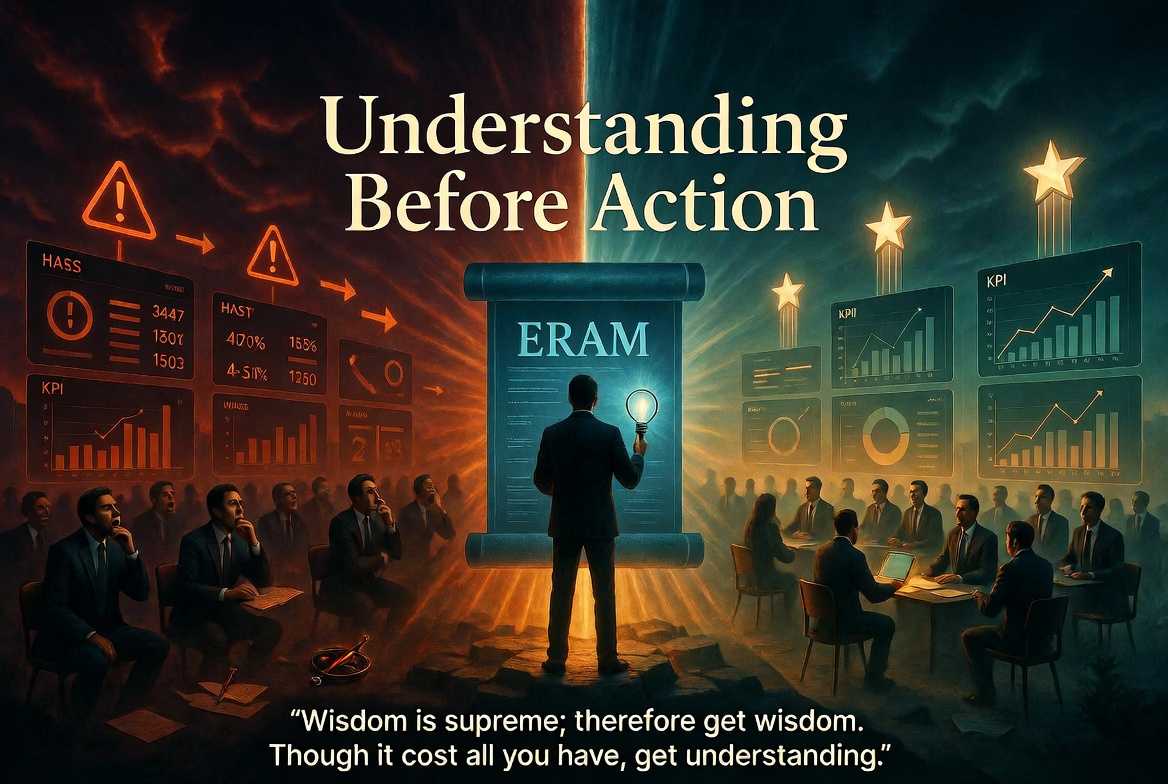
Understanding before action
Understanding Before Action – Why Organizations Misinterpret Their Own Data
“Wisdom is supreme; therefore get wisdom. Though it cost all you have, get understanding.” — Proverbs 4:7
Introduction: The Missing Layer Between Data and Decisions
Most organizations believe their greatest challenge is obtaining data.
For decades, companies invested heavily in data warehouses, reporting platforms, dashboards, business intelligence tools, and analytics programs. The assumption was simple:
If we have enough data, we will make better decisions.
Today, many organizations have more data than ever before.
Yet poor decisions remain common.
Projects fail.
Forecasts miss expectations.
Investments underperform.
Resources are misallocated.
The problem is no longer access to information.
The problem is interpretation.
Organizations increasingly possess data without understanding.
This distinction is critical because understanding is the missing layer between information and action.
Data does not create decisions.
Understanding creates decisions.
The Difference Between Knowledge and Understanding
One of the most important themes throughout biblical wisdom literature is the distinction between knowledge, understanding, and wisdom.
Knowledge answers:
What happened?
Understanding answers:
Why did it happen?
Wisdom answers:
What should we do next?
Many reporting systems stop at knowledge.
Dashboards display information.
Reports summarize activity.
KPIs measure performance.
These are valuable.
But they do not automatically produce understanding.
An organization may know sales declined.
That does not mean it understands why.
An organization may know downtime increased.
That does not mean it understands the root cause.
An organization may know customer acquisition costs rose.
That does not mean it understands what action should follow.
The Illusion of Insight
Modern dashboards often create what might be called the illusion of understanding.
Information appears organized.
Charts look impressive.
Metrics appear precise.
Executives feel informed.
Yet organizations frequently act on incomplete interpretations.
This happens because visibility is often mistaken for understanding.
Seeing data is not the same as interpreting data correctly.
This distinction explains why organizations with sophisticated reporting systems can still make poor decisions.
Joseph: A Biblical Model of Interpretation
One reason Joseph's story remains so relevant is that he demonstrates the difference between information and understanding.
Others possessed the information.
Pharaoh had the dreams.
The cupbearer had the memory.
The baker had the experience.
Joseph possessed the interpretation.
His value did not come from access to information.
His value came from understanding what the information meant.
This principle applies directly to modern analytics.
Data alone rarely creates competitive advantage.
Correct interpretation does.
The Danger of Acting Too Quickly
Organizations often move from information directly to action.
A KPI changes.
A metric declines.
A dashboard highlights a trend.
Leaders immediately respond.
Sometimes this works.
Often it creates unintended consequences.
The issue is not lack of action.
The issue is action without understanding.
Proverbs repeatedly warns against haste.
Not because action is wrong.
Because understanding should precede action.
Understanding creates confidence.
Action without understanding creates risk.
Why AI Makes Understanding More Important
Artificial intelligence introduces an interesting challenge.
AI excels at generating information.
It can:
- summarize reports
- identify anomalies
- forecast outcomes
- recommend actions
- generate insights
However, AI does not necessarily understand context.
This distinction is increasingly important.
Organizations may soon have unlimited access to recommendations.
The scarce resource will become interpretation.
Why does this recommendation matter?
What assumptions exist?
What business conditions influence the result?
What risks accompany the recommendation?
AI can accelerate information.
Understanding remains a human responsibility.
The ERAM Perspective: Building Understanding Into Architecture
The Eden Reporting Architecture Method is ultimately a framework for creating understanding.
Each step contributes to interpretation quality.
Step 1: Define Business Objective
Understanding begins with purpose.
Without a clearly defined objective, information lacks context.
A KPI may appear important while being irrelevant to the actual business decision.
Defining objectives ensures interpretation occurs within the correct framework.
Step 2: Define Grain
Many misunderstandings originate from grain confusion.
Users compare metrics operating at different levels of detail.
Conclusions become distorted.
Understanding requires clarity about what the data actually represents.
Step 3: Transform Data
Transformation determines how information is presented.
Poor transformations create misleading interpretations.
Correct transformations support meaningful understanding.
Step 4: Enforce Star Schema
Architectural clarity improves interpretive clarity.
Well-structured models make relationships easier to understand.
Poor architecture obscures meaning.
Understanding becomes more difficult.
Step 5: Build Layered DAX
Layered calculations create transparency.
Users can trace logic.
Assumptions become visible.
Interpretation improves because calculations remain explainable.
Step 6: Stress Test Model
Understanding requires confidence.
Stress testing verifies that reported results remain reliable under varying conditions.
Interpretation improves when trust exists.
Step 7: Validate With Source
Validation protects understanding.
Incorrect information inevitably produces incorrect conclusions.
Reliable interpretation depends upon trustworthy data.
Step 8: Design Dashboard
Visualization should support understanding rather than merely displaying information.
The purpose of dashboards is not decoration.
The purpose is clarity.
Manufacturing Example: Misinterpreting Performance
Consider a manufacturing organization experiencing declining throughput.
The dashboard clearly identifies the problem.
Throughput is decreasing.
The information is accurate.
The interpretation is not.
Leadership assumes labor productivity is the cause.
Additional staffing investments are approved.
Months later performance remains unchanged.
Further investigation reveals equipment downtime was the actual constraint.
The data existed from the beginning.
The misunderstanding occurred during interpretation.
The cost was not data quality.
The cost was poor understanding.
CRM Example: Misinterpreting Customer Behavior
A CRM team notices declining conversion rates.
The dashboard highlights the trend.
Leadership concludes lead quality has deteriorated.
Marketing strategies are adjusted.
Budgets are reallocated.
Results fail to improve.
Eventually the organization discovers the true issue.
Sales qualification standards changed several months earlier.
The conversion decline reflected a process change rather than deteriorating lead quality.
Again, the data existed.
The misunderstanding occurred during interpretation.
The Real Value of Analytics
Many organizations believe analytics exists to provide answers.
In reality, analytics often exists to improve questions.
The best analysts rarely rush toward conclusions.
They investigate.
They challenge assumptions.
They seek context.
They search for understanding.
The goal is not simply knowing what happened.
The goal is understanding why it happened and what should happen next.
The ERAM Audit and Organizational Understanding
One of the most valuable aspects of an ERAM Audit is its ability to identify where understanding is being lost.
The audit evaluates:
- KPI definitions
- business objectives
- governance practices
- architectural design
- validation processes
- reporting trust
Many organizations discover they possess large amounts of information but relatively little understanding.
The challenge is not generating more reports.
The challenge is improving interpretation.
The Future Belongs to Organizations That Understand
Technology will continue advancing.
AI will continue generating insights.
Dashboards will continue becoming more sophisticated.
Information will become increasingly abundant.
Understanding will become increasingly valuable.
The organizations that thrive will not necessarily be those with the most data.
They will be those that understand their data most effectively.
Because understanding transforms information into action.
And action creates results.
Conclusion
The modern business world often celebrates information.
Biblical wisdom places greater value on understanding.
Knowledge explains what happened.
Understanding explains why.
Wisdom determines what to do next.
Organizations that confuse information with understanding often make costly mistakes.
Organizations that pursue understanding before action build stronger decision systems.
This is why reporting architecture matters.
The objective is not merely producing reports.
The objective is creating understanding.
Because data alone does not create value.
Understanding does.
And understanding remains one of the most powerful competitive advantages any organization can possess.
Previous Article: Counting the cost
Next Article: Discernment before decisions
Related Resources
Why good data still leads to bad decisions
Knowledge is not enough : why data teams still fail
Discover the Eden Reporting Architecture Method (ERAM) — a practical framework for building trusted decision infrastructure, KPI alignment, and scalable reporting systems.
Evaluate your reporting environment with an ERAM Audit and identify hidden risks related to KPI definitions, reporting trust, governance, and decision-making reliability.
