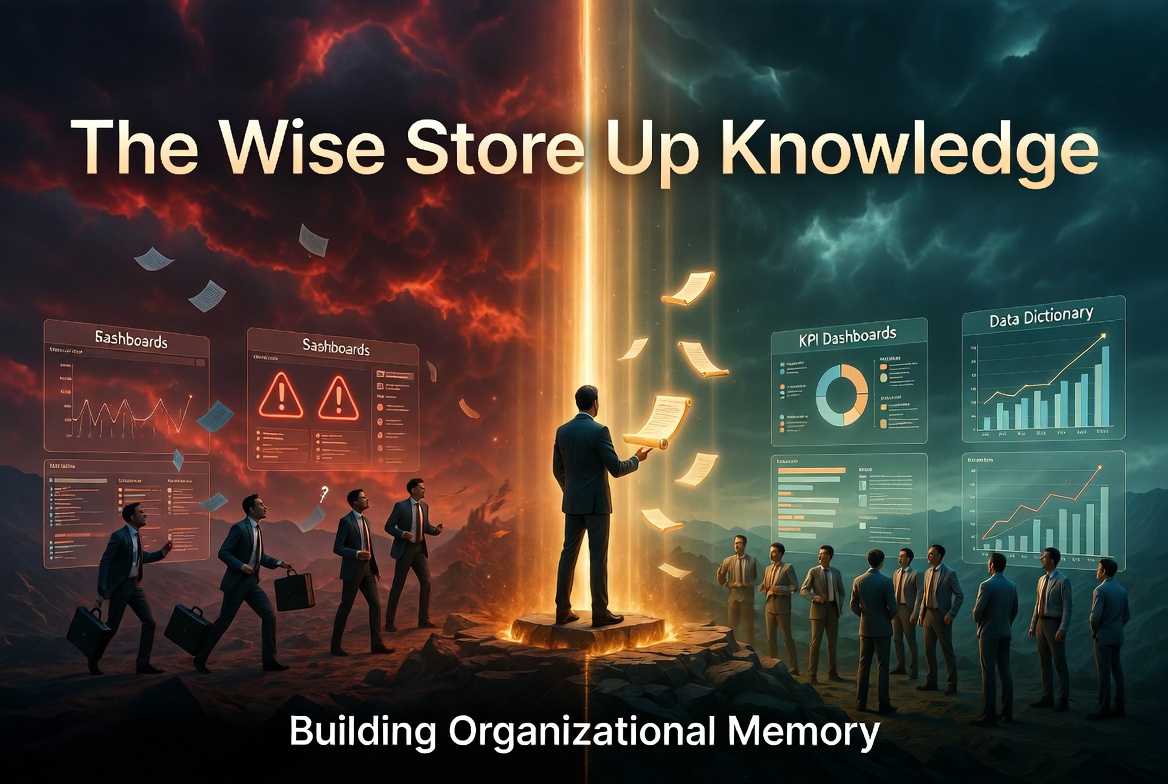
The wise store up knowledge
The Wise Store Up Knowledge – Building Organizational Memory
“The wise store up knowledge, but the mouth of a fool invites ruin.” — Proverbs 10:14
Introduction: The Knowledge That Walks Out the Door
Every organization possesses knowledge.
Some of it is documented.
Some of it is embedded in systems.
Some of it exists in processes.
But much of it exists inside people's heads.
This creates a hidden risk that many organizations underestimate.
Employees leave.
Managers retire.
Analysts change roles.
Consultants complete engagements.
And suddenly critical knowledge disappears.
The organization discovers that what appeared to be a reporting system was actually a collection of undocumented assumptions held together by a few key individuals.
The dashboards remain.
The understanding leaves.
This is why organizational memory has become one of the most important and least appreciated aspects of decision infrastructure.
The Difference Between Information and Organizational Memory
Many organizations confuse information with knowledge.
Information can be stored.
Knowledge can be understood.
Organizational memory goes one step further.
It preserves understanding across time.
A dashboard may display a KPI.
Organizational memory explains:
- why the KPI exists
- how it is calculated
- who owns it
- what assumptions support it
- when it should be used
Without organizational memory, information gradually loses meaning.
The organization remembers the number.
It forgets the story behind the number.
Biblical Wisdom and Knowledge Preservation
Proverbs repeatedly emphasizes the value of storing knowledge.
This is more than collecting information.
It is preserving wisdom for future use.
Throughout Scripture, important lessons were documented, repeated, and transmitted across generations.
The objective was not merely learning.
The objective was retention.
Knowledge that cannot be retained cannot be stewarded.
The same principle applies to organizations.
A company that repeatedly relearns the same lessons is paying the cost of forgotten knowledge.
The Hidden Cost of Knowledge Loss
Most organizations recognize turnover costs.
Few recognize knowledge-loss costs.
Consider what happens when a senior analyst leaves.
Documentation may be incomplete.
Business rules may be undocumented.
Metric definitions may exist only through experience.
New team members spend months reconstructing knowledge that already existed.
This creates:
- delays
- errors
- inconsistent decisions
- duplicated effort
The organization pays repeatedly for the same knowledge.
The Problem of Hero-Based Reporting
Many reporting environments depend heavily on a few individuals.
One analyst understands the model.
One developer understands the calculations.
One manager understands the definitions.
One consultant understands the business logic.
At first this appears efficient.
In reality it is fragile.
The organization becomes dependent upon individuals rather than systems.
When those individuals leave, organizational memory leaves with them.
Wise organizations avoid hero-based reporting.
They build memory into the architecture itself.
Why AI Increases the Importance of Organizational Memory
Many leaders assume artificial intelligence reduces dependency on human knowledge.
The opposite is often true.
AI depends heavily on context.
It depends on:
- definitions
- business rules
- governance
- assumptions
- historical understanding
Organizations with weak organizational memory frequently struggle to use AI effectively because the necessary context does not exist in a structured form.
AI can retrieve knowledge.
It cannot preserve knowledge that was never documented.
The organizations that benefit most from AI will often be those with the strongest knowledge management practices.
ERAM and Organizational Memory
The Eden Reporting Architecture Method creates organizational memory at every stage.
Each step converts individual knowledge into institutional knowledge.
Step 1: Define Business Objective
Objectives must be documented.
Future users need to understand why a reporting solution exists.
Without documented purpose, systems lose context.
Step 2: Define Grain
Grain decisions represent critical architectural knowledge.
If grain is not documented, future modifications become risky.
Step 3: Transform Data
Transformation logic captures business understanding.
Documented transformations preserve organizational memory.
Undocumented transformations create dependency on individuals.
Step 4: Enforce Star Schema
Structured architecture improves transparency.
Future teams can understand the system more easily.
Knowledge becomes embedded within design.
Step 5: Build Layered DAX
Layered calculations improve maintainability.
Business logic becomes traceable.
Institutional knowledge becomes visible.
Step 6: Stress Test Model
Testing results preserve valuable operational learning.
Future teams understand known limitations and behaviors.
Step 7: Validate With Source
Validation procedures create repeatable trust.
Knowledge becomes reproducible rather than dependent on specific individuals.
Step 8: Design Dashboard
Well-designed dashboards communicate meaning consistently across time.
The goal is not simply displaying information.
The goal is preserving understanding.
Manufacturing Example: Retirement and Operational Knowledge
Many manufacturing organizations face a growing challenge.
Experienced employees retire.
Decades of operational knowledge leave with them.
A plant manager may understand:
- quality patterns
- production bottlenecks
- maintenance relationships
- supplier risks
Much of this knowledge may never be documented.
The same problem often exists in reporting systems.
Metric definitions remain informal.
Business logic remains tribal knowledge.
Governance remains unwritten.
Retirement exposes the weakness.
Organizations discover that critical knowledge was never institutionalized.
The wise store up knowledge before it is needed.
CRM Example: Customer Knowledge Loss
CRM environments face similar risks.
High-performing sales leaders often possess deep customer knowledge.
Marketing leaders understand attribution nuances.
Operations teams understand process exceptions.
Without documentation, these insights disappear during turnover.
Forecasting becomes less accurate.
Reporting becomes less consistent.
Decision quality declines.
Strong organizational memory protects continuity.
The Data Dictionary as Modern Stewardship
One of the most underrated governance tools is the data dictionary.
A well-maintained data dictionary preserves:
- KPI definitions
- ownership
- business rules
- calculation logic
- source information
Many organizations view documentation as administrative work.
Biblical stewardship suggests otherwise.
Documentation is preservation.
Preservation is wisdom.
The Semantic Model as Organizational Memory
Modern semantic models represent more than technical structures.
They capture organizational understanding.
Relationships, definitions, calculations, and business logic become centralized.
The semantic model becomes a living repository of institutional knowledge.
When implemented properly, it reduces dependency on individuals and improves continuity.
The ERAM Audit and Knowledge Risk
One of the most valuable outcomes of an ERAM Audit is identifying organizational memory risks.
The audit evaluates:
- documentation maturity
- KPI governance
- ownership clarity
- architectural transparency
- knowledge preservation practices
Organizations frequently discover that key knowledge exists only within specific individuals.
This creates significant long-term risk.
The audit helps transform fragile knowledge into durable knowledge.
The Competitive Advantage of Organizational Memory
Technology changes rapidly.
Employees come and go.
Markets evolve.
Organizational memory creates stability.
Organizations with strong memory:
- onboard faster
- scale more effectively
- adapt more quickly
- recover more easily from turnover
They spend less time rediscovering old lessons.
They spend more time creating new value.
This advantage compounds over time.
The Wisdom of Building Memory Before You Need It
The ant stores provisions before winter.
Wise organizations store knowledge before disruption.
Waiting until critical employees leave is too late.
Waiting until governance fails is too late.
Waiting until definitions are forgotten is too late.
Organizational memory should be built proactively.
The greatest value often becomes visible only after the original knowledge holders have moved on.
Conclusion
The wise store up knowledge.
This principle applies as much to organizations as it does to individuals.
Reporting systems are not merely collections of dashboards.
They are repositories of organizational understanding.
When knowledge remains trapped inside individuals, organizations become fragile.
When knowledge is documented, governed, and embedded into architecture, organizations become resilient.
The future belongs to organizations that preserve what they learn.
Because knowledge creates understanding.
Understanding creates wisdom.
And wisdom creates better decisions.
The organizations that thrive will not simply collect information.
They will build organizational memory.
And that memory will become one of their most valuable assets.
Previous Article: Many plans, one counsel
Next Article: Testing every spirit (AI Recommendations)
Related Resources
Seek first – The missing principle behind every great decision system
Discover the Eden Reporting Architecture Method (ERAM) — a practical framework for building trusted decision infrastructure, KPI alignment, and scalable reporting systems.
Evaluate your reporting environment with an ERAM Audit and identify hidden risks related to KPI definitions, reporting trust, governance, and decision-making reliability.
